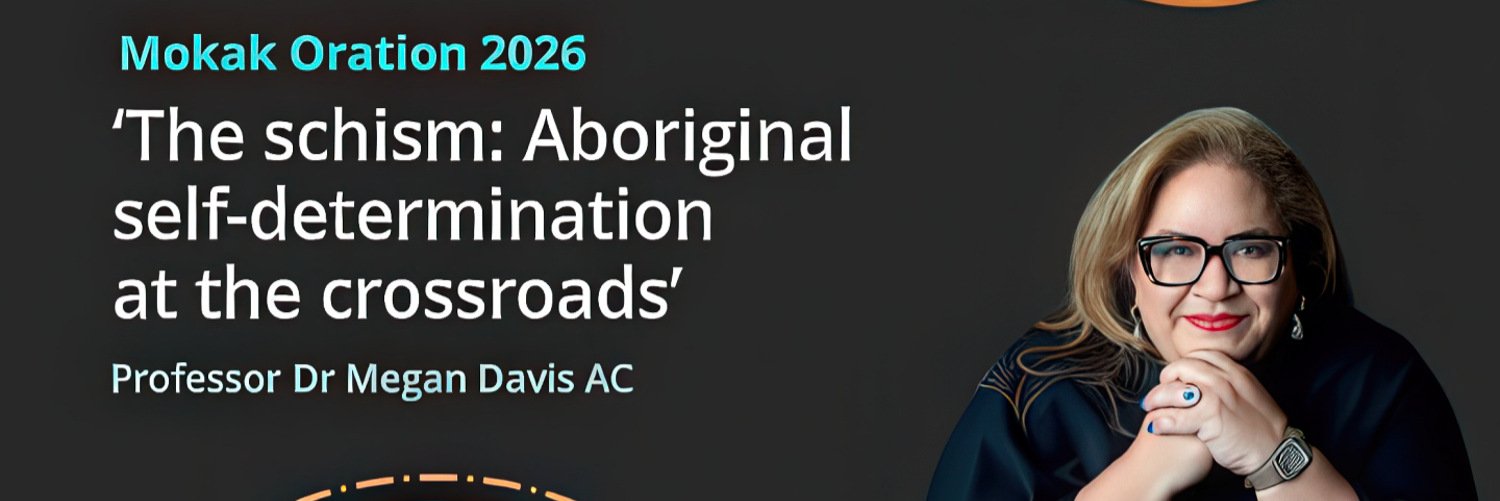
Without a Federal Voice, the Gap Will Not Close: Megan Davis’s 2026 Mokak Oration
A critical appreciation of “The schism: Aboriginal self-determination at the crossroads”: three years after the referendum, Davis finds self-determination divided between bodies funded to speak and representatives chosen to speak, between the haves and the have-nots, and between the Commonwealth and the states.
Three years to the day after the referendum
Megan Davis delivered the 2026 Mokak Oration in Canberra on 14 October 2026, the third anniversary of the Voice referendum, and her verdict was stark: “without a federal voice, the gap will not close.”
She found Aboriginal self-determination divided against itself. Her oration names several schisms, and three drive its argument:
The first runs through Aboriginal public life, between bodies funded to speak for communities and representatives those communities choose.
The second runs through the government’s flagship economic policy, between the haves and the have-nots.
The third runs through the federation, between a Commonwealth that took responsibility for Aboriginal affairs in 1967 and the states to which it has since returned much of that responsibility.1
She did not choose the date. The Productivity Commission, which hosts the Mokak Oration each year in honour of its first Aboriginal Commissioner, Romlie Mokak, had set it without noticing the coincidence.1 Davis made full use of it. She began by speaking to the people for whom 14 October remains a hard day: those “who all felt a deep sense of hurt and devastation by the vote”. She described being stopped “every day by mob who hug me and want to talk quietly about what we experienced in a country that after the referendum does not seem very interested in how we felt.”
The official mood after October 2023, she argues, held that the Australian people had made “a judicious decision” and that the nation should put the matter behind it: “There was nothing to see.” Against that mood, the oration insists that something remains to be seen, and that it is more than the hurt of a lost vote. It is “the torment of our powerlessness”, the phrase she takes from the Uluru Statement from the Heart:2 the material conditions that made a Voice seem necessary in the first place, and that remain. “The post-referendum state,” she says, “has merely shone a light on the structural challenges that persist.” She declines both of the easy responses to defeat, grievance and silence, and chooses analysis instead.
Davis is a constitutional lawyer, and she presents herself as one: “My focus in my work is on structures of the state.” She refuses to blame one government: “This is not an Albanese problem or an Albanese government problem. It is the problem, or the fact, of how our federalism has developed.” That generosity is strategic as well as sincere. It denies listeners the comfort of a partisan reading and leaves them facing the architecture itself.
A referendum judged by a double standard
Davis then turns to the referendum campaign, and her point reaches beyond the Voice. She describes “the preponderance of bots, political lies, disinformation, and the torrent of unimaginable racism passed over in silence by our elected representatives.”
She asks why the country dismissed these at the time as “sour grapes” or as “legitimate political contestation”, while it treats the same phenomena elsewhere as threats to democratic integrity. Her answer is that Indigenous peoples are “fenced out of the growing concerns about misinformation and disinformation”. The “asymmetrical application” of the standard, she says, “raises critical questions for our democracy more broadly.”
Her reframing makes the referendum a test of the health of Australian democracy as a whole, beyond a closed episode in Indigenous affairs. It also links to her sharp legal point about what has followed. Some elected officials have treated a failed amendment to the text of the Constitution as a mandate to abandon things that were never on the ballot: the flying of the Aboriginal and Torres Strait Islander flags, both official flags of the Commonwealth, and the practices of acknowledgement and welcome to country. As a matter of law, a No vote decides only that the text stays as it was. Davis calls the claimed mandate “deeply worrying” and treats it as a failure of civic understanding, which it is. If anything, her word is restrained.
Witnesses from inside and outside government reach one verdict
Many people speak in this address. Davis quotes Romlie Mokak and Ken Wyatt, the two previous orators. She quotes Noel Pearson on the Uluru Statement as “Australia’s great unrequited love letter from the first Australians to Australians”. She quotes the 1991 Royal Commission into Aboriginal Deaths in Custody. She quotes Michael Dillon, a former senior official who worked for three federal ministers for Indigenous affairs, and Sean Gordon, a Wangkumarra and Barkindji business and community leader. She quotes Eddie Cubillo, the Larrakia law professor who resigned from the national Justice Policy Partnership. And she recalls the five senior Aboriginal leaders in the Northern Territory who left their posts in recent months.
An oration about who gets to speak for Aboriginal people is itself polyphonic: a chorus of witnesses from inside government, from community organisations, from the law, and from business, all describing the same failure from different positions. Davis shows that people who sat at the table, people who walked away from it, and people who were never invited share one diagnosis.
The witnesses are well chosen, and their testimony holds. The ABC reported in September 2026 that the head of Aboriginal Housing NT, the Northern Territory Children’s Commissioner, the chair of the Territory’s children and families forum, and an independent Arnhem Land parliamentarian, among others, had all resigned. Most said they could not make their voices heard.3 Cubillo’s words, which Davis reads in full, record the same verdict: the justice elements of Closing the Gap “had failed”, and he “could no longer be part of a process that had become a vehicle for delay, not justice”.1 When Davis says “we cannot keep pretending that this is working”, she repeats what Cubillo and the Territory leaders had already said.
Self-determination measured by one woman’s life
Early in the oration Davis turns personal. She recalls her doctoral work on the Aboriginal and Torres Strait Islander Commission, and her long concern with the place of Aboriginal women in representative institutions. Then she makes a claim that few people in Indigenous public life make so plainly:
“A thorough understanding of the right to self-determination cannot be solely concerned with what is best for the collective or the community… often advocacy for rights as collectives means that the interests and the issues of the individuals that make up the collective are treated in a very reductionist way.”
In place of the collective abstraction she puts a short question: “The question is, what is she actually able to do and to be.” She draws it, by name, from the capabilities approach of Amartya Sen and Martha Nussbaum, which judges justice by what people can actually do and become, beyond formal rights or averages. Applied to self-determination, it changes the test. Consultation of “the community” no longer settles the matter. The test becomes whether the woman in that community can live a dignified life: eat, be safe, raise her children, be heard.
The question sits uneasily beside Davis’s own insistence, in 2023, that “First Nations are collectives, not individuals.”4 The oration resolves the tension without naming it. A collective serves a woman’s capabilities when she and her neighbours chose the people who speak for it, and it fails her when someone else chose them. The individual test and the collective right meet in a single question: who chose the representatives? That question governs each of the three schisms.
It also explains her concern with gender. Davis helped design the National Congress of Australia’s First Peoples with equal representation of men and women, “the first constitution of its kind”. The Voice design principles set the same commitment: the body would be “representative of Aboriginal and Torres Strait Islander communities, with a gender-balance and include youth”.5 So when she says the referendum loss was also “a loss for gender equality more broadly in Australia”, she draws a connection that public debate about the Voice almost entirely missed. A body of Aboriginal women chosen by their own communities, speaking with authority to the national parliament, would have been something new in Australian democracy. The whole country bears the cost of its absence.
First schism: funded to speak, or chosen to speak
The first schism runs through Aboriginal public life itself. Davis names “in-the-room privilege”: the access some have to government, and to government resources, “without any real clear mapping or understanding of the accountability of such entities back to the communities for whom they speak.” She gives its result the name development economists use, elite capture:
“Elite capture happens when the advantaged few steer resources and institutions that could serve the many toward their own narrower interests and aims.”
The sector is small, and everyone in it knows everyone else. Davis speaks with care: “This observation is not to ascribe any negative intent to anyone, but to describe a phenomenon that occurs in public policy.” The fault she identifies lies mainly with governments, which “assume such entities are unequivocally representative because it’s convenient and neat to do so.” She extends real sympathy to those inside the tent, who are “equally frustrated” by broken promises and resistance from bureaucracies. And she draws a firm line: none of this questions the legitimacy of elected bodies. The problem is the gap between being funded to speak and being chosen to speak.
People across the sector, she says, are “reluctant to say what they really think because of fear of jeopardizing their funding. The concept of unfreedom comes to mind.” Self-determination is meant to be the opposite of dependence, yet Davis describes a system in which the very organisations meant to bring Aboriginal voices into government cannot speak freely to it. She sets beside it the Royal Commission’s words of 1991, which now read as an indictment of what has happened since:6
“Government can transform the picture of Aboriginal affairs, not so much by doing things, more by letting go of the controls… They know the solutions because they live with the problems.”
The official data supports her verdict on the framework those controls produced. The Productivity Commission’s July 2026 report found that of nineteen Closing the Gap targets, one has been met and three are on track. Five are improving too slowly, and four are getting worse, including suicide, adult imprisonment, and the number of children in out-of-home care.7 The phrase she borrows from Dillon to describe what governments have built, “everyone’s priority and no one’s responsibility”, is as concise a description of that failure as anyone has offered.
Peak bodies have an answer to her charge. Many answer to community-controlled member organisations whose boards their communities elect, and they can argue that this chain of election makes them representative. Davis’s distinction meets that reply directly. A chain of incorporated bodies, each answerable to its funders as well as to its members, differs from representatives whom the people of a region choose to speak to government. The first may serve communities well; only the second can claim to speak for them.
Davis knows the risk of naming elite capture in her own sector, and she takes it because the alternative is worse: a politics in which those with most access speak for the people with least power, and nobody says so. She frames the problem as a fault of structure, leaving character aside, and so makes it possible to discuss. Whether the sector takes up that discussion is one of the real tests the oration sets.
Second schism: a flagship policy for the haves
The second schism runs through the government’s flagship policy since the referendum: economic empowerment, which the Prime Minister announced at the Garma Festival in August 2025. Davis supports economic self-determination and says so explicitly: it “is a part of the framework of the right to self-determination”. Her concern is who benefits, and who decides. A policy anchored in successful native title determinations, she points out, offers little to the urban dispossessed, whose native title the law extinguished, and whose promised reparations fund through the Indigenous Land Fund “has not really eventuated.”
Here she brings in Sean Gordon, whom nobody could accuse of hostility to enterprise. Gordon, who has spent his career building Aboriginal economic participation, warned that “there is an ever-increasing gap between Aboriginal people themselves. Those who have capability, capacity, influence are doing quite well out of these types of announcements, whilst many of our people are being left behind.” Michael Dillon is blunter: picking winners “is fine until you begin picking losers”, and the policy, “like Rumpelstiltskin, promises to spin straw into gold”.8
Then Davis allows herself the oration’s one moment of open anger, and it is earned. To elevate wealth creation as a flagship policy in the same season that children are in youth detention and in crisis in child protection is, she says, “repugnant.” She ends the thought with a sentence that needs no gloss: wealth creation talk “matters little when kids are starving and have no food.” The restraint of the rest of the address gives that word its force. A speaker who has been scrupulously fair for forty minutes is entitled to say what she feels.
Third schism: Canberra hands the 1967 mandate back to the states
The third schism lies in Davis’s own professional field, the structure of the state. Her argument is that the 2020 National Agreement on Closing the Gap “saw the federal government devolve far too much responsibility to the states and territories”, and that this misreads both the Constitution and the nation’s history:
“It seems to me a profound misreading of the Australian Constitution and of the High Court’s interpretation of federalism to imagine that the states and territories can adequately discharge responsibility for Indigenous affairs in the absence of a coherent national framework, in the absence of a federal voice and in the absence of federal leadership.”
Behind it lies a historical claim. One of the central impulses behind the 1967 referendum, she argues, “was the manifest failure of the states to protect the rights and welfare of Aboriginal people.” In 1967, 90.77 per cent of voters agreed to give the Commonwealth power to make laws for Aboriginal people, the highest Yes vote in any federal referendum.9
She calls this, with Dillon, “the 1967 covenant”. The word needs defending, because the amendment conferred a power and imposed no legal duty. A covenant, though, binds by promise: it names an expectation so widely shared that breaking it counts as a betrayal even where no court would enforce it. The 1967 vote created that expectation of national leadership. Henry Reynolds has traced the demand that Aboriginal affairs become a national responsibility back to the early twentieth century.10 Davis’s point is that the present arrangements quietly hand that responsibility back to the governments the 1967 vote was meant to correct.
The states deliver most of the services at stake, including policing, youth justice, and child protection. Davis asks the Commonwealth to lead, which differs from asking it to deliver: to set the national framework, to hear a national voice, and to answer for the result. Her image for the present arrangement is memorable: “Aboriginal Australia just continues to be a political football game with no rules.” With the states left “carrying the can for the have-nots”, the Commonwealth is free to announce bespoke policy for the haves. The federal and economic schisms turn out to be the same schism, seen from two angles.
From compass to blueprint
Davis draws the threads together: “The schisms I’ve raised, from gender, incorporation and corporations versus communities, incorporation versus individual agency, the haves and the have-nots, the winners and the losers”. These tensions are “made more acute,” she says, “by the federal withdrawal from leadership in a space that was mandated to them by the Australian people in 1967.” Then she returns to Ken Wyatt, and lets his words take her into the close:11
“These are the soft shackles, polished, polite, but powerful. They exist not just in laws, but in habits, not just in prejudice, but in process. They remind us that colonisation was never just an event. It is a system that must continually be redesigned out of existence.”
And, still with Wyatt: “They are the legacy of well-meaning reform without enduring architecture, and they will persist until we embed Indigenous design into the institutions of the state. If William Cooper’s petition was the moral beginning, the unfinished business of our time is the structural completion.”
Finishing in her predecessor’s words is generous, and it is also an argument. Wyatt was the first Aboriginal person to serve as federal minister for Indigenous Australians, and he left his party over its opposition to the Voice.12 By closing with his lines, Davis places her structural case inside a continuous Aboriginal tradition of advocacy that runs from William Cooper’s 1930s petition to the King, through the Uluru Statement, to the present. The phrase “soft shackles” names exactly what her whole oration describes: the polite, procedural forms of control that replaced the iron of the past, and that work through funding agreements, consultation protocols, and the convenient assumption that whoever is in the room speaks for everyone.
Wyatt had ended his oration by calling the Uluru Statement “our compass”.11 Davis says she will end the same way, and then changes one word: “the Uluru Statement from the Heart remains our blueprint.” A compass gives direction; a blueprint gives a design. The word is an old one for her. In 2018 she endorsed Mark McKenna’s description of the Statement as “the blueprint for an Australian republic.”13 For a constitutional lawyer whose whole argument concerns architecture, and who helped design the process that produced the Statement, the change is deliberate. The Uluru Statement is a plan for the structure as well as a moral orientation, and it remains on the table.
Her final sentence turns on repetition:
“We can’t change the reality that without a federal voice, the gap will not close, and without a federal voice, so that people can be assured that the people who are giving advice to government are chosen from their own communities, Aboriginal and Torres Strait Islander people will never be able to achieve the right to self-determination.”
The close redefines the purpose of a Voice. It presents the Voice as a guarantee of legitimacy: the assurance that “the people who are giving advice to government are chosen from their own communities.” That assurance answers elite capture, in-the-room privilege, and unfreedom at once, and every earlier point in the oration leads to it.
The close also refuses to let the verdict of 2023 stand as the last word. Three years to the day after the vote, in the national capital, to the agency now reviewing the national framework, Davis states without apology that the Voice remains the necessary condition. Her refusal to put October 2023 behind her is deliberate.
And the close ends on the words of the title. The oration’s subtitle is “Aboriginal self-determination at the crossroads”, and its final word is “self-determination”. The crossroads is now clear. One road leads to communities choosing their own representatives; the other leads to more of what the preceding forty minutes have described.
Where the argument is most demanding
The closing claim is absolute: without a federal Voice, Aboriginal and Torres Strait Islander people will “never be able to achieve” self-determination. It comes three years after the electorate declined to create one. Some will hear it as a counsel of despair. I read it as a refusal to lower the standard, and her standard is a test that any reform can meet or fail: did their communities choose the people who advise government?
Two Australian bodies already meet that test. South Australia’s First Nations Voice, created by statute, has advised that state’s Parliament since the election of its members in March 2024.14 Victoria’s First Peoples’ Assembly, elected by First Peoples since 2019, now forms part of Gellung Warl, the representative body the Statewide Treaty established.15 These cases test her “never”. They show that communities can choose their own representatives below the level of the Constitution, and that governments will hear them.
They also show the limit Davis identifies. Each body speaks to one state, and each rests on an Act that a later parliament can repeal. The Victorian Coalition has pledged to repeal the Statewide Treaty Act if it wins office at the November 2026 election.16 Queensland’s Parliament has already abolished its own Path to Treaty machinery, closing its Truth-telling and Healing Inquiry in November 2024.17 No state body can answer the Commonwealth’s withdrawal from the 1967 mandate. On that reading, her “never” is a precise claim: state Voices can meet her test in state affairs, but self-determination in a federation needs a voice where the Commonwealth makes its decisions.
Until that voice exists, the oration hands its audience a yardstick. Regional and legislated representative bodies, accountability for funded organisations, and a Commonwealth that takes back its lead role in the national agreement each pass or fail on her terms. Building the interim structures falls to the rest of us.
Finally, the oration asks something concrete. The Productivity Commission’s second review of the National Agreement is open, and initial submissions close on Monday 26 October 2026.18 Davis calls it “a very watershed moment for Indigenous policy” and urges “our people, our communities, our peaks, our collectives, and individuals living in community” to take part. Whatever else the oration achieves, it gives the review its central question.
Who chose you, and to whom do you answer?
This is one of the most important statements on Aboriginal self-determination since the referendum. It takes the grief of a national defeat and turns it into a precise structural account of why the gap is not closing. Its originality lies in measuring self-determination by the life of the individual woman as well as by the standing of the collective, and in showing that the two meet when communities choose their own representatives. Its courage lies in naming the schisms within Aboriginal public life as well as those between Aboriginal people and the state. Every schism it describes comes back to one question: who chose you, and to whom do you answer?
Davis closes with a blueprint where her predecessor offered a compass, and with a sentence that refuses to let October 2023 decide the future. On the anniversary of the vote, that refusal made the right closing note.
What to do next
- Make a submission to the Closing the Gap Review 2026 before Monday 26 October 2026.
- Watch the oration in full; Davis begins at the 22:30 mark.
- Read the companion essay Why Professor Megan Davis Challenges You to Stop Being an Ally.
- Read the companion essay Goodwill Has No Leverage: Megan Davis and the Demands of Structural Justice.
- Start with the five quick-start actions.
Notes
1. Productivity Commission, “The schism: Aboriginal self-determination at the crossroads”, 2026 Mokak Oration by Professor Dr Megan Davis AC, Canberra, 14 October 2026; and the Commission’s Mokak Oration page, which records that the oration honours Romlie Mokak, the Commission’s first Aboriginal Commissioner. The Commission had published no transcript at the time of writing. Quotations from the oration, including the words of Eddie Cubillo that Davis read, come from the author’s viewing of the live stream recording, in which Davis begins speaking at 22:30.
2. Uluru Statement from the Heart, 26 May 2017.
3. ABC News, “String of NT Aboriginal leaders resign, claiming CLP government policies are ‘dividing’ Territorians”, 19 September 2026.
4. Megan Davis, “Voice of Reason: On Recognition and Renewal”, Quarterly Essay 90, June 2023 (extract).
5. The Voice design principles agreed by the Referendum Working Group, 23 March 2023, as reproduced in the Parliamentary Library’s Bills Digest, “Constitution Alteration (Aboriginal and Torres Strait Islander Voice) 2023”.
6. Royal Commission into Aboriginal Deaths in Custody, National Report, 1991, as quoted by Davis in the oration.
7. Productivity Commission, Closing the Gap Annual Data Compilation Report, July 2026, released 29 July 2026: of the nineteen targets, one met (preschool enrolment), three on track, five improving but not on track, four worsening (children developmentally on track, adult imprisonment, children in out-of-home care, and suicide), two unchanged, and four not assessable.
8. Megan Davis, “Garma chameleon”, The Monthly, September 2025, on the economic empowerment policy the Prime Minister announced at the Garma Festival in August 2025.
9. National Archives of Australia, “The 1967 Referendum”: 90.77 per cent voted Yes, the highest Yes vote recorded in a federal referendum; the amendment removed the words excluding Aboriginal people from section 51(xxvi) and repealed section 127.
10. Henry Reynolds, “Aborigines and the 1967 Referendum: Thirty Years On”, Papers on Parliament No. 31, Department of the Senate, June 1998.
11. Ken Wyatt, “Breaking the shackles: from moral courage to structural justice”, 2025 Mokak Oration, Canberra, 4 November 2025 (the Commission’s page for the oration lists it as “Releasing the shackles: from past to present”). The published text reads: “These are the soft shackles – polished, polite, but powerful”; “colonisation was never just an event; it is a system that must continually be redesigned out of existence”; “They are the legacy of well-meaning reform without enduring architecture”; “If William Cooper’s petition was the moral beginning, the unfinished business of our time is the structural completion”; and “The Uluru Statement from the Heart remains our compass.”
12. SBS News, “Former Indigenous Australians minister Ken Wyatt quits the Liberal Party over its Voice stance”, April 2023.
13. Megan Davis, “The status quo ain’t working”, The Monthly, 2018.
14. First Nations Voice to Parliament (South Australia), “About the Voice”: a representative, legislatively created, elected body whose inaugural members were elected in March 2024.
15. Premier of Victoria, “Gellung Warl to represent First Peoples in Victoria”, 8 May 2026; and Victorian Government, “Treaty timeline”, which records the Assembly’s first general member elections in September and October 2019.
16. ABC News, “Victorian Liberals to scrap statewide Treaty if elected”, 14 October 2025.
17. Truth-telling and Healing Inquiry, closure notice: the Inquiry ceased on the repeal of the Path to Treaty Act 2023 on 29 November 2024.
18. Productivity Commission, Closing the Gap Review 2026: terms of reference received 28 August 2026; initial submissions due Monday 26 October 2026; draft report April 2027; final report to the Joint Council by 28 August 2027.