How to Tell Whether Queensland Is Reducing the Detention of First Nations Children
Governments, advocates, and reporters all make claims about child detention in Queensland. In five steps you can find the official measure, read the records beneath it, weigh what the oversight bodies and First Nations organisations say, and judge the Government’s decisions on the evidence. Each step names the source, what it can establish, and where it stops.
An evidence trail is a research guide, not an argument. My evidence briefs state findings; this trail shows you how to reach them yourself, and how to test anyone else’s. It uses the sources in my Trusted Sources directory and stops where they stop.
Five kinds of material appear along the way, and the trail keeps them apart: observed facts, such as a count of children in detention on an average day; the limits of the data, such as how a rate depends on a population estimate; the interpretations institutions place on those facts; what Aboriginal and Torres Strait Islander organisations say the facts mean for their children; and my own conclusions, which appear only at the end, marked as mine. On the first two, the statistical authorities have the stronger claim. On the fourth, the community-controlled organisations do.
Start With the Official Measure
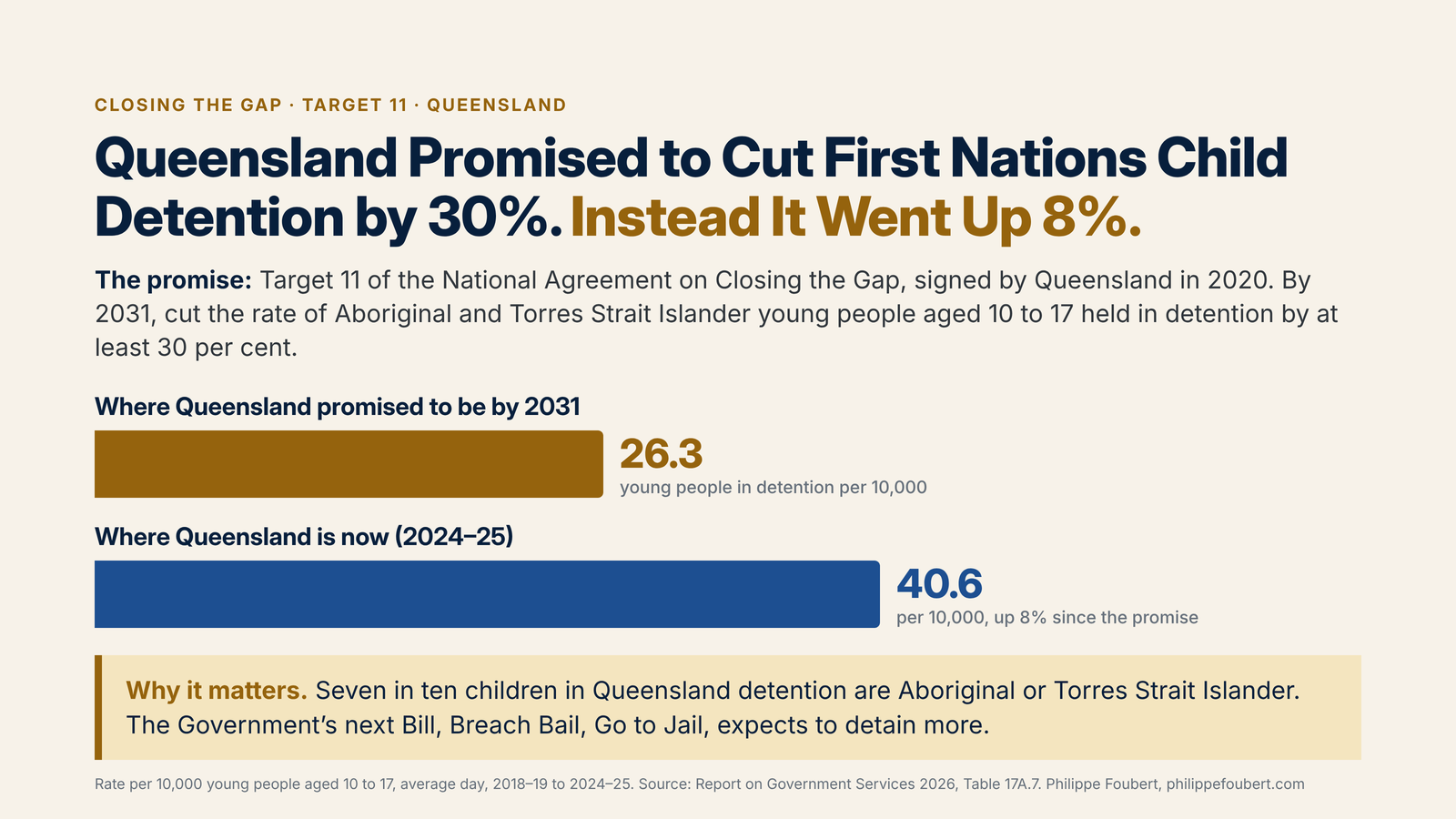
Target 11 commits governments, by 2031, to reduce the rate of Aboriginal and Torres Strait Islander young people aged 10 to 17 in detention by at least 30 per cent. The rate counts young people in detention on an average day, per 10,000 of the population of that age, and the baseline is 2018–19. Nationally the rate stood at 25.7 per 10,000 in 2024–25, and the Productivity Commission assesses no change from the baseline. Queensland’s rate rose from 37.6 in the baseline year to 40.6 in 2024–25, an increase of about 8 per cent, and has stood above the baseline for three years running.
One point decides many arguments. The target is national. The Commission states that there are no state and territory targets, and it assesses each state’s progress as movement from that state’s own baseline: improvement, worsening, or no change. When a page, including mine, speaks of the rate Queensland needs to reach, it applies the national commitment to Queensland’s baseline, as the Commission does. Queensland never signed a separate number, and no one can fairly say it did. It did sign the Agreement, and its own youth justice strategy states a specific focus on Target 11.
Productivity Commission — Target 11 dashboard
Annual (July)The official assessment: the national rate, each state’s rate and direction from baseline, and the Commission’s own statement that the target is national and no state targets exist.
Establishes Whether the national rate and Queensland’s rate are moving towards or away from the target. Stops at Why. The dashboard measures; it does not explain.
Report on Government Services — Section 17, Table 17A.7
Annual (January)The year-by-year series behind the dashboard: detention rates for Aboriginal and Torres Strait Islander and non-Indigenous young people in every jurisdiction, with the ratio between them. The Queensland Family and Child Commission compiles the Queensland series from it.
Establishes The trend across years, and the over-representation ratio. Stops at Comparisons across jurisdictions where the footnotes record different counting rules.
Examine the Records Beneath the Measure
The detention counts come from the national youth justice collection, which the Australian Institute of Health and Welfare compiles from each state’s records and reports in Youth justice in Australia. The Report on Government Services draws on the same collection. Yet the two publications can print slightly different figures for the same year: the Institute reports that on an average day in 2024–25, First Nations young people were 71 per cent of those in Queensland detention and 27 times as likely to be detained; the Report on Government Services gives 72 per cent and 26 times. Before you compare any two figures, check each publication’s edition date, its age range (10 to 17, or 10 and over), whether it counts an average day or everyone detained during the year, and the population estimate it divides by. Small differences there produce small differences in the rate, and a careless comparison turns them into a false trend.
Three facts in the records carry more weight than the headline rate. On an average day in 2024–25, 252 of the 285 young people in Queensland detention, 88 per cent, had not been sentenced. Queensland recorded the highest number of Aboriginal and Torres Strait Islander children aged 10 to 13 in detention of any jurisdiction, 91, who were 73.4 per cent of all children of that age in Queensland detention. And police records put Queensland’s 2024–25 youth offender rate at its lowest point in eleven years, 36.8 per cent below 2014–15. Detention has risen while recorded offending has fallen, which points to the system’s response rather than to the children.
Before you compare two numbers
Every rate on this trail divides a count of children by an estimate of the population their age. The Australian Bureau of Statistics revises those estimates after each Census, and the first results of the 2026 Census arrive in June 2027, so a rate can change between editions without a single child moving. Indigenous status in justice records depends on identification at the point of contact, which varies between jurisdictions and over time. And the pandemic years of 2019–20 to 2021–22 explain the only sustained dip in Queensland’s series, so a comparison that starts in one of those years flatters whatever follows.
AIHW — Youth justice in Australia 2024–25
Annual + quarterlyThe national collection, with supervision and detention for every jurisdiction, First Nations rates and ratios, and the quarterly Youth detention population in Australia series.
Establishes Counts, rates, and over-representation on a consistent national definition. Stops at Why a child is in detention. The collection records status, not reasons.
Queensland’s own figures, supplied by the Department of Youth Justice and Victim Support: unsentenced detention, remand stays, and First Nations detention rates, with the President’s commentary.
Establishes How much of Queensland’s detention is remand, and how long remand lasts. Stops at National comparison; its definitions are Queensland’s.
Police-recorded offender rates across an eleven-year series, each offender counted once a year, with youth and adult rates separated.
Establishes Whether recorded youth offending rose or fell while detention changed. Stops at Offending itself. Police records measure what police detect and charge, so a change in policing changes the count.
ABS — Aboriginal and Torres Strait Islander Peoples
Five-yearly + ongoingThe population estimates that form the denominator of every rate in this trail, rebased after each Census.
Establishes The population base, and when it changes. Stops at The Census counts those who identify; the estimates carry that limit into every rate.
Read What the Oversight Bodies Found
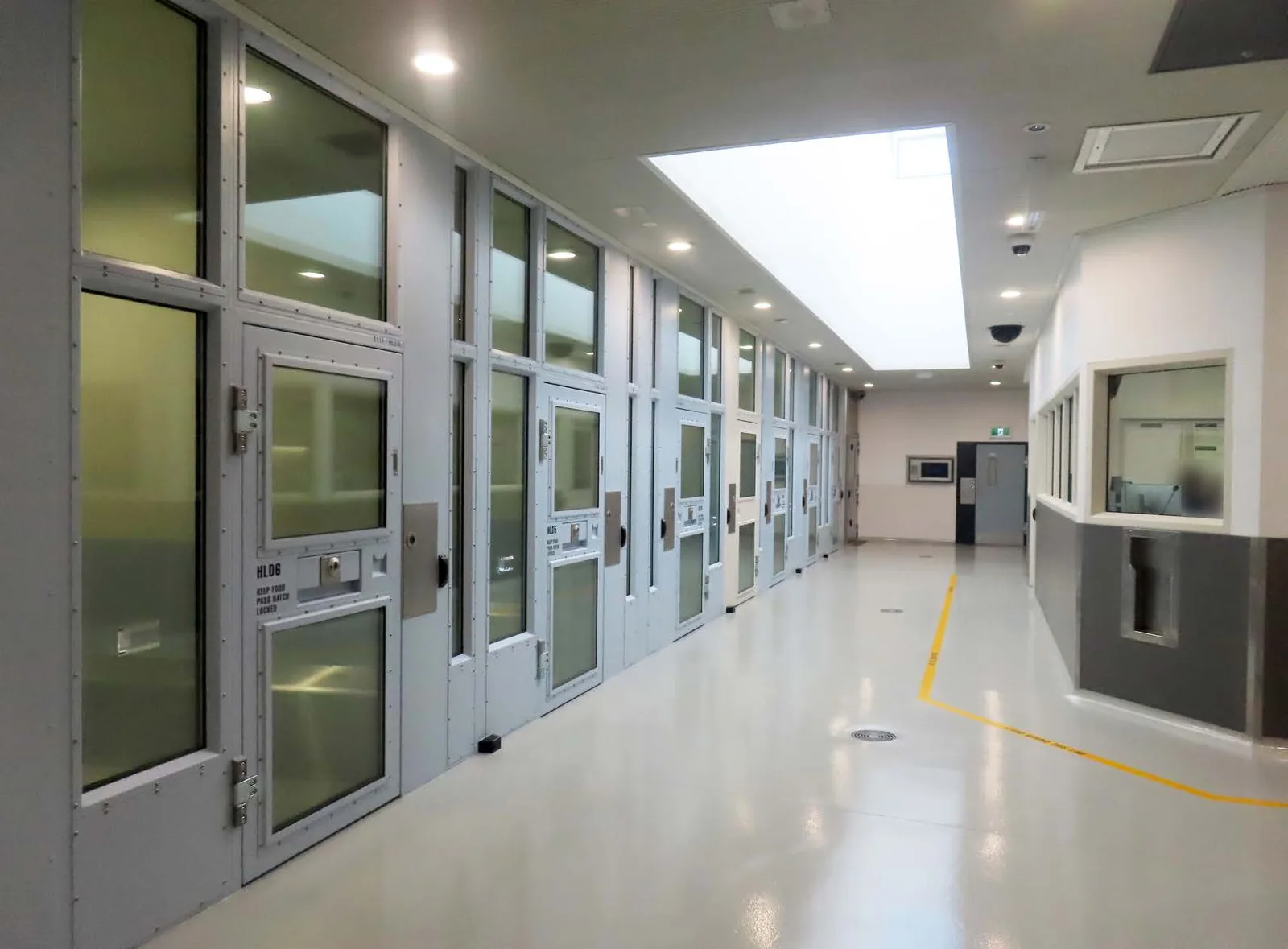
The Inspector of Detention Services, within the Queensland Ombudsman, inspected all three youth detention centres in 2025 and recorded that 60 per cent of children at West Moreton, 62 per cent at Brisbane, and 90 per cent at Cleveland identified as Aboriginal or Torres Strait Islander. His report on Wacol, tabled on 8 October 2026, found the converted watch-house unsuitable for children and withdrew his own draft call to close it, because the Government’s bail Bill may fill every youth detention bed in the state. Read that sequence as evidence of capacity, not only of conditions.
Two further offices complete the picture. The Office of the Public Guardian’s community visitors see children in detention under the Public Guardian Act 2014, and the National Commissioner for Aboriginal and Torres Strait Islander Children and Young People, a Commonwealth statutory office since 1 July 2026, told Queensland’s Parliament that its primary recommendation was that the bail Bill not pass.
Queensland Inspector of Detention Services
Rolling + annualInspection reports on youth detention centres, prisons, and watch houses, with the department’s response appended. The Wacol report and the combined 2025 inspections report are the current ones.
Establishes Conditions, who is held, and the Inspector’s own forecasts of capacity. Stops at Numbers after the inspection date; the second Wacol report comes in 2027.
National Commission for Aboriginal and Torres Strait Islander Children and Young People
Ongoing + annualThe independent Commonwealth commission for First Nations children, whose submission on the bail Bill recommended that Parliament not pass it.
Establishes A statutory, First Nations-led assessment of the Bill against children’s rights. Stops at Enforcement; the Commission recommends, and Queensland decides.
The state body under the Human Rights Act 2019 (Qld), the Act the bail Bill overrides. Its submissions and guidance set out which rights a Bill engages and how.
Establishes The rights at stake and the Commission’s view of the override. Stops at Remedy; an override declaration removes the Act from the field.
Office of the Public Guardian — Community Visitors
Ongoing + annualStatutory visitors who see children in youth detention and raise the issues they find, reported in the Public Guardian’s annual report.
Establishes What children themselves raise with an independent visitor. Stops at Detail; the annual report aggregates.
Read the First Nations Responses
QATSICPP, Queensland’s Youth Justice Peak since May 2024, consulted 64 of its youth justice-funded members on the bail Bill. It opposes the new offence, the mandatory minimum, the “high degree of confidence” test, the removal of mandatory diversion, and the override of the Human Rights Act, and asks at the least that children aged 10 to 13 be excluded. ATSILS (Qld) opposes the Bill, warning that it will worsen the over-representation of Aboriginal and Torres Strait Islander people in custody. The nearest published evidence supports them: under New South Wales’s equivalent test for children, Aboriginal and Torres Strait Islander young people were 79 per cent of the cases in which it applied and 84 per cent of those refused bail.
Note the sequence as well as the content. The Bill reached Parliament on 27 August 2026 with papers that name no organisation consulted; the Youth Justice Peak’s role was to respond, within eleven days, to a Bill already written. Whether a government shared a decision is itself a fact the record can establish.
The Queensland peak for Aboriginal and Torres Strait Islander child protection and family support services, and the state’s Youth Justice Peak. Its submissions to Parliament record the sector’s position and the consultation it ran.
Establishes The sector’s position and the terms of its consultation. Stops at The Government’s reasons for setting that advice aside, which the papers do not give.
ATSILS Queensland
OngoingThe community-controlled legal service that represents the children the Bill reaches, and sees the bail decisions as they are made.
Establishes How the law works in court, from the lawyers who appear. Stops at Statistics; its evidence is practice, not counts.
NATSILS
OngoingThe national peak for Aboriginal and Torres Strait Islander legal services, whose chair responded to the Senate’s youth justice report on the day it appeared, 18 September 2026.
Establishes The national legal sector’s position and its record of inquiries ignored. Stops at Queensland detail, which QATSICPP and ATSILS supply.
Change the Record
OngoingThe national First Nations-led justice coalition, campaigning to end the mass incarceration of, and violence against, First Nations people.
Establishes The national First Nations-led case for change, across jurisdictions. Stops at Queensland data; it argues from the national record.
Judge the Government’s Decisions on Its Own Papers
The Attorney-General introduced the Breach Bail, Go to Jail and Other Legislation Amendment Bill 2026 on 27 August 2026, and the Bill fixes its own commencement for 30 November 2026. Its statement of compatibility states: “It is anticipated that these reforms will increase the number of children and adults held on remand or otherwise detained in youth detention centres or police watch-houses.” Its statement about exceptional circumstances states that the Government “accepts that these new provisions are incompatible with human rights.” Neither paper uses the words Aboriginal, Torres Strait Islander, Indigenous, First Nations, or Closing the Gap, and neither gives an estimate of numbers or cost. The Justice, Integrity and Community Safety Committee reported on 16 October 2026 and recommended that Parliament pass the Bill; Labor told the committee in writing that it will support it.
When the vote comes, read Hansard with one rule in mind. If a member calls a division, Hansard records how each member voted. If the Bill passes on the voices, no individual votes exist on the record, and the most you can report is the outcome and each party’s stated position. A claim that names who voted for a Bill passed on the voices is a claim the record cannot support.
The Bill’s text, explanatory notes, statement of compatibility, and statement about exceptional circumstances, on the Office of the Queensland Parliamentary Counsel’s site; after assent, the Act and its commencement.
Establishes What the law says and what the Government conceded in writing. Stops at Effect; the papers forecast and do not count.
Justice, Integrity and Community Safety Committee
Report, 16 October 2026The committee’s report, the public submissions, the hearing transcripts, and the party positions recorded in the report.
Establishes What Parliament was told, by whom, and what the committee made of it. Stops at The vote, which belongs to the House.
Queensland Parliament — Hansard
Each sitting dayThe verbatim record of the second reading debate, the outcome, and any division.
Establishes What members said, the outcome, and individual votes if a member called a division. Stops at Individual votes on the voices, which are never recorded.
High Court of Australia — NAAJA v Northern Territory
Judgment pendingThe challenge to section 7A(2AB) of the Bail Act 1982 (NT), the Territory’s “high degree of confidence” bail test, heard by the Full Court on 8 and 9 October 2026 with Queensland among the intervening governments.
Establishes Whether a test of this kind survives constitutional challenge. Stops at Queensland’s Bill directly; the judgment will bear on it, not decide it.
What the Evidence Can and Cannot Establish
The evidence establishes:
- Queensland’s detention rate for First Nations young people in 2024–25 stood about 8 per cent above its 2018–19 baseline, and has stood above it for three years running, while the national rate shows no change.
- Nearly nine in ten young people in Queensland detention on an average day have not been sentenced.
- Police-recorded youth offending in Queensland is at its lowest in eleven years. Detention has risen as recorded offending has fallen.
- The Government expects its bail Bill to hold more children on remand, and has said so in writing.
- The Youth Justice Peak, the state’s community-controlled legal service, and the National Commissioner all advised against the Bill, and the papers record no consultation before it was written.
The evidence does not establish:
- That Queensland adopted a separate state target. The target is national; the Commission assesses each state from its own baseline.
- That any single law caused the rise. Four instruments in 21 months and a pandemic dip make a single-cause claim unsafe.
- How many more children the Bill will detain, or how many of them will be First Nations. The Government has published no modelling.
- Which members voted for the Bill, unless a member called a division.
Follow Evidence Trail 2: deaths in custody in Queensland Read my youth justice evidence brief Open the full Trusted Sources directory