
How to Check What Happens After a Death in Custody in Queensland
A death in custody sets a legal process in motion: a report to the State Coroner, an investigation, a mandatory inquest, findings, recommendations, and a published government response. Each stage leaves a public record. In five steps you can find the national count, the law that binds the coroner, the findings in a particular death, what the Government did with the recommendations, and what the First Nations organisations that watch this process say.
An evidence trail is a research guide, not an argument. The first trail, on child detention, followed a single number through its sources. This one follows a process, because the question after a death in custody is rarely how many; it is what the state did next, and whether anyone can see it. Every source below sits in my Trusted Sources directory, and the trail stops where the sources stop.
The same five kinds of material appear here as in the first trail, kept apart: observed facts, the limits of the data, the interpretations institutions place on the facts, what Aboriginal and Torres Strait Islander organisations say the facts mean, and my own conclusions, which come last and are marked as mine.
Start With the National Count, and Read It Three Ways
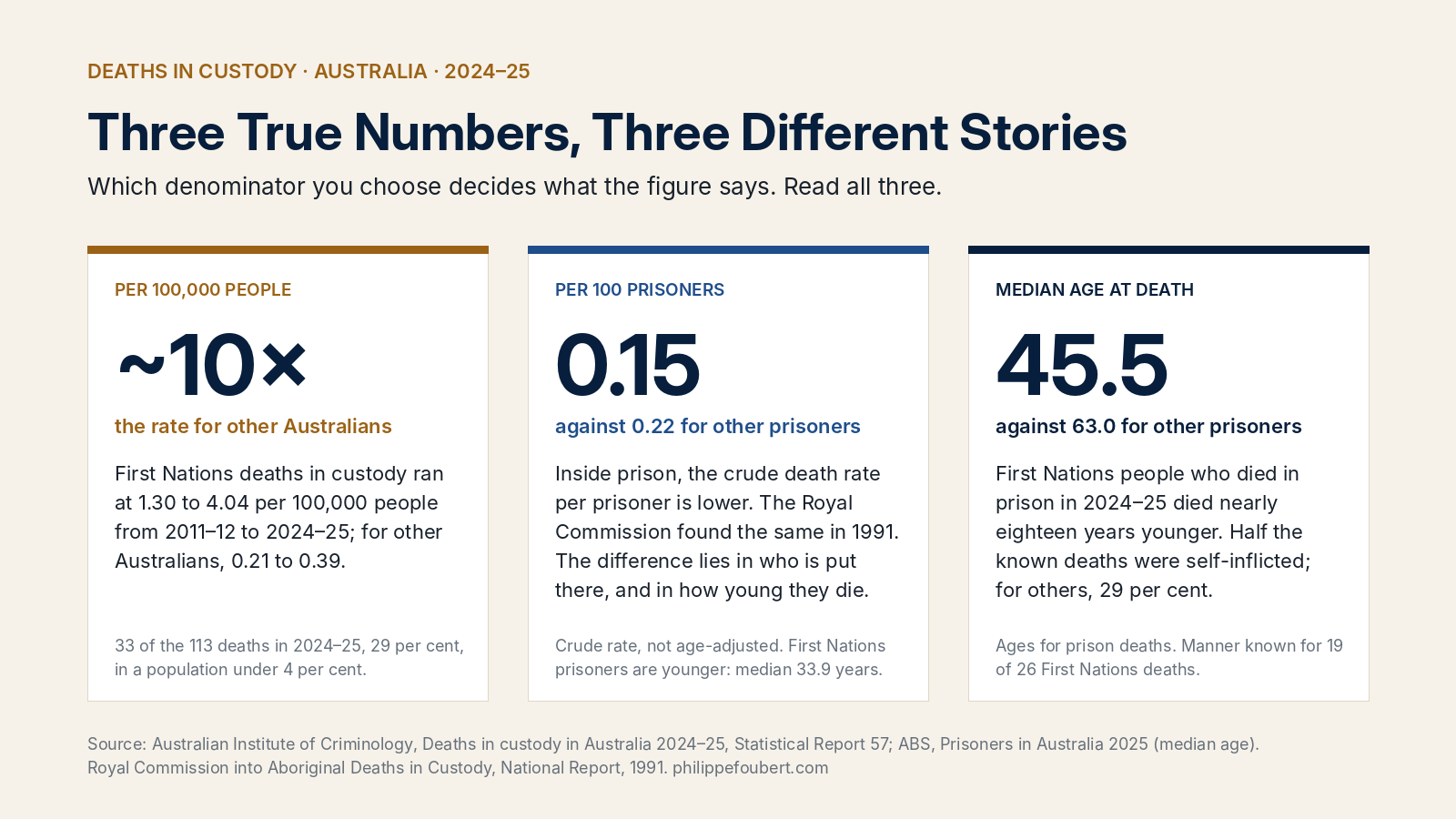
In 2024–25, 113 people died in custody in Australia: 90 in prison, 22 in police custody or custody-related operations, and one in youth detention. Thirty-three were Aboriginal or Torres Strait Islander people, the largest number in any year since the collection began in 1979–80; 26 of them died in prison, which is also the highest prison figure on record. The Institute’s statistics page, as it read on 21 October 2026, puts the total at 540 First Nations deaths in custody since the Royal Commission. Queensland recorded three First Nations deaths in prison custody in 2024–25 and none in police custody or custody-related operations.
Now read the count against the population. The Institute reports that from 2011–12 to 2024–25, First Nations deaths in custody ran at 1.30 to 4.04 per 100,000 First Nations people, against 0.21 to 0.39 per 100,000 for other Australians: about ten times the rate, for a people under 4 per cent of the population who were 29 per cent of the dead in 2024–25. Read it next against the prison population. In 2024–25, 0.15 First Nations prisoners in every 100 died, against 0.22 of every 100 other prisoners. The Royal Commission found the same in 1991: “Aboriginal people in custody do not die at a greater rate than non-Aboriginal people in custody. However, what is overwhelmingly different is the rate at which Aboriginal people come into custody,” and so, “put simply, Aboriginal people died in custody in disproportionate numbers because they were in custody in disproportionate numbers.”
Read it last against age, which is where the per-prisoner rate hides the most. First Nations people who died in prison in 2024–25 had a median age of 45.5; other prisoners who died, 63.0. First Nations prisoners are younger (a median of 33.9 years, against 36.6 for all prisoners), and a crude rate that counts the natural deaths of old men among other prisoners flatters the comparison; the Institute publishes no age-standardised rate. Of the 19 First Nations prison deaths with a known manner, ten were self-inflicted, against 29 per cent among others. A speaker who cites only the per-prisoner rate hides the age gap; a speaker who cites only the count hides the Royal Commission’s finding. Each half is usually the half that would complicate the speaker’s case. The over-representation that every measure records begins with the decisions that fill the prisons, which is where the first trail begins.
Before you quote a figure
The Institute’s real-time dashboard counts notifications as they arrive, and those figures are preliminary. The annual report records that cause and manner of death were available for 19 of the 26 First Nations prison deaths of 2024–25 when it went to press, that the coroner had yet to determine intent in all ten self-inflicted deaths, and that seven borderline deaths await coronial outcomes before the Institute decides whether they count. A figure from the report can therefore change in the next edition, and a figure from the dashboard can change next week.
Statistical Report 57, by Merran McAlister, Hannah Miles, and Samantha Bricknell: deaths by custodial authority, Indigenous status, jurisdiction, cause and manner, with rates per 100 prisoners and the tables behind the figures above.
Establishes Verified counts and rates for the year, and the trend since 1979–80. Stops at Deaths still before the coroner, whose cause, manner, and sometimes inclusion remain open.
AIC — Deaths in Custody Dashboards
Continuous + quarterlyThe real-time and quarterly dashboards of the National Deaths in Custody Program, with the running total since the Royal Commission.
Establishes That a death has been notified, and the running totals. Stops at Verification; the quarterly dashboard follows about two months after each quarter, and the annual report settles the figures.
The Commission’s finding on rates, quoted above, as the Social Justice Commissioner set it out in 2001 ten years on, with the 339 recommendations that followed.
Establishes The baseline finding every later rate is read against. Stops at 1991; the Institute’s reports carry the measure forward.
The prisoner census at 30 June: 17,432 Aboriginal and Torres Strait Islander prisoners in 2025, 37 per cent of all prisoners, at a median age of 33.9 years against 36.6 for all prisoners.
Establishes The denominator of the per-prisoner rate, and the age profile that makes it crude. Stops at Deaths; it counts the living.
Find the Legal Duty the Death Creates
Under section 10 of the Coroners Act 2003 (Qld), a death is a death in custody if the person was in custody, escaping or trying to escape from custody, or trying to avoid being put into custody; the Act’s own example is a suspected bank robber who dies in a car crash while police pursue him. Custody means detention, by a police officer or anyone else, under an arrest, a court order, or an Act of the State or the Commonwealth, with three exclusions for education, mental health, and forensic disability law. Detention under the Youth Justice Act 1992 falls within it. Section 7 requires an immediate report of the death to the State Coroner or a Deputy State Coroner; section 11 requires one of them, or a coroner approved for the purpose, to investigate it; and section 27(1)(a)(i) requires the coroner to hold an inquest. Section 46 lets the coroner comment on public health or safety, the administration of justice, and ways to prevent deaths in similar circumstances, and those comments are the recommendations the rest of this trail follows.
Who investigates before the coroner does matters as much as the inquest. The Queensland Police Service’s Ethical Standards Command investigates a death during a police operation, with the Crime and Corruption Commission overseeing the investigation; an apparent suicide in a correctional centre draws an inquiry by the police Corrective Services Investigation Unit. In each case the first investigators belong to the system in which the person died, and the coroner is the first independent set of eyes. When you read a finding, note what the coroner says about the quality of that first investigation.
Coroners Act 2003 (Qld)
StatuteThe current Act on the Queensland Legislation site: section 10 (death in custody), section 7 (reporting), section 11 (who investigates), section 27 (when an inquest must be held), and section 46 (coroner’s comments).
Establishes The duties, in the words that bind. Stops at Practice; the Act says what must happen, and the findings say whether it did.
Caxton Legal Centre’s plain-language guide to who investigates a death in police operations or in a correctional centre, the six-month expectation for those investigations, and the oversight the Crime and Corruption Commission provides.
Establishes The investigative sequence before the inquest, in plain terms. Stops at Authority; it explains the law and does not make it.
Read the Coroner’s Findings in the Particular Death
The Coroners Court of Queensland publishes inquest findings and the list of upcoming inquests. Its search offers a year, a type (inquest or non-inquest), and a keyword box, but no category for deaths in custody, so search the keyword “custody” and the year, or follow the Institute’s count to the names. The findings delivered on 11 August 2026 into the death of James Michael Watson show what a finding holds: the Deputy State Coroner classifies a police shooting in South Brisbane in October 2022 as a death in custody, which made the inquest mandatory, sets out the sequence of events, decides whether the officers’ use of force was appropriate, and records any comments under section 46. Read the classification, the cause and manner, the assessment of the first investigation, and the recommendations, in that order.
Note the dates as you read. Watson died in October 2022; the findings came in August 2026. An inquest can take years, and until it concludes the Institute’s count holds the death with its cause and manner open. The gap between the death and the finding is itself a fact the record establishes, and the families waiting inside it are the reason the Royal Commission asked for the count in the first place.
Every published finding since 2004, searchable by year, type, and keyword, with the list of upcoming inquests beside it.
Establishes Cause, manner, the coroner’s assessment of the investigation, and the recommendations. Stops at Deaths without findings yet, and deaths the coroner handled without an inquest, which appear only as non-inquest findings if published at all.
Findings into the death of James Michael Watson
11 August 2026Deputy State Coroner Stephanie Gallagher’s findings into a death in custody following a police shooting, delivered in Brisbane: a worked example of the classification, the sequence, and the assessment of force.
Establishes What one complete finding contains. Stops at The general case; every death is found on its own facts.
Track What the Government Did With the Recommendations
The Queensland Government aims to publish a response to each coronial recommendation within six months of the findings, and then to report on implementation twice a year until the recommendation is implemented or the Government decides not to support it. From 2008 to 2012 those responses appeared in annual reports; since 2012 the Department of Justice posts each response on the Queensland Courts website beside the findings it answers. The place to look, therefore, is the finding’s own page, and the question to ask is whether a response exists, what it accepts, and whether the implementation updates have kept coming.
At the national level, the Commonwealth commissioned Deloitte Access Economics in 2017 to review the Royal Commission’s 339 recommendations. The review found 78 per cent fully or mostly implemented across all governments, 16 per cent partially implemented, and 6 per cent not implemented. In 2021 researchers at the Australian National University’s Centre for Aboriginal Economic Policy Research, Thalia Anthony, Kate Jordan, Tamara Walsh, Francis Markham, and Megan Williams, drew on coronial inquest findings to argue that the review “may have misrepresented the extent to which the RCIADIC recommendations had been implemented,” and that governments’ failure to implement key recommendations had fatal consequences for First Nations people. A percentage of recommendations implemented is a claim about paperwork; a coroner’s finding that a recommendation was ignored in a particular death is a claim about practice. The second is the stronger evidence.
Queensland Government — Response to Coronial Recommendations
Six months, then twice yearlyThe Department of Justice’s statement of how the Government responds: within six months of the findings, posted beside them on the Courts website, with implementation updates twice a year.
Establishes The commitment, and where each response sits. Stops at Compliance; check the finding’s page for the response and the dates of its updates.
The Deloitte Access Economics review commissioned in 2017: 78 per cent of the 339 recommendations fully or mostly implemented, 16 per cent partially, 6 per cent not.
Establishes Governments’ own account of implementation. Stops at Independent verification, which the ANU paper below supplies from coronial findings.
Anthony, Jordan, Walsh, Markham, and Williams test the Deloitte findings against coronial inquest reports and new evidence, indexed by the Indigenous Justice Clearinghouse.
Establishes Where coroners found recommendations unimplemented in particular deaths. Stops at 2021; later findings need the same reading.
The research index kept by the Commonwealth, every state and territory, the Australian Institute of Criminology, and the New Zealand Government, which gathers deaths-in-custody research and datasets in one place.
Establishes What research exists, and where the datasets sit. Stops at Judgement; it indexes and does not assess.
Read the First Nations and Independent Records
The Royal Commission’s recommendations put the Aboriginal legal services at the centre of the response to custody, and they remain there. ATSILS Queensland runs the after-hours custody notification line that police call when they take an Aboriginal or Torres Strait Islander person into custody, and its lawyers see the custody decisions as they happen; NATSILS speaks for the legal services nationally; Change the Record is the national First Nations-led coalition on incarceration and violence; Sisters Inside, an Aboriginal-led Queensland organisation, speaks for women and girls in prison. The Inspector of Detention Services, a statutory office, inspects the places where people die. Guardian Australia’s Deaths Inside database records every Indigenous death in custody since 1 January 2008 with the coronial detail the official count omits; it is journalism, and the Indigenous Justice Clearinghouse indexes it as a dataset on that understanding.
ATSILS Queensland
OngoingThe community-controlled legal service for Queensland. Free call 1800 012 255: business hours for all legal matters, and after hours for custody notifications only.
Establishes What happens at the point of custody, from the lawyers notified. Stops at Statistics; its evidence is practice.
NATSILS
OngoingThe national peak for Aboriginal and Torres Strait Islander legal services, whose statements follow each death in custody and each inquest finding.
Establishes The legal sector’s national position and its record of recommendations ignored. Stops at Queensland detail, which ATSILS supplies.
Change the Record
OngoingThe national First Nations-led justice coalition, campaigning to end the mass incarceration of, and violence against, First Nations people.
Establishes The national First Nations-led case for change after each death. Stops at Queensland data; it argues from the national record.
Sisters Inside
OngoingAn Aboriginal-led Queensland organisation advocating for the human rights of women and girls in prison and their families.
Establishes The experience of women in Queensland custody, from those who work with them. Stops at Men’s custody, where most deaths occur.
Queensland Inspector of Detention Services
Rolling + annualThe statutory inspector, within the Queensland Ombudsman, that examines prisons, youth detention centres, and watch houses and publishes what it finds, with the department’s response appended.
Establishes Conditions in the places where deaths occur, before a death. Stops at Individual deaths, which belong to the coroner.
Guardian Australia — Deaths Inside
Journalism, from 2008The Guardian’s database of Indigenous deaths in custody since 1 January 2008, built mainly from coronial findings and, for recent deaths, from media and police statements, indexed as a dataset by the Indigenous Justice Clearinghouse.
Establishes The detail of each death and the pattern across them, in one place. Stops at Official status; it is journalism, and the Institute’s count remains the record of reference.
What the Evidence Can and Cannot Establish
The evidence establishes:
- Thirty-three Aboriginal and Torres Strait Islander people died in custody in 2024–25, the most in any year since the national count began in 1979–80, and 26 of them died in prison.
- First Nations people die in custody at about ten times the rate of other Australians per head of population, and those who died in prison in 2024–25 died nearly eighteen years younger, at a median age of 45.5 against 63.0.
- Per prisoner, the crude death rate for First Nations prisoners, 0.15 per 100, was lower than for other prisoners, 0.22 per 100, as the Royal Commission found in 1991. The count reflects whom the state imprisons; the per-prisoner rate reflects what happens inside, before age enters the comparison.
- Queensland law requires an immediate report of every death in custody to the State Coroner, an investigation by a senior coroner, and an inquest, and it allows the coroner to recommend how to prevent similar deaths.
- The first investigators of a death in police operations or in prison belong to the police service, with the Crime and Corruption Commission overseeing police cases; the coroner is the first independent examiner.
- Queensland commits to a public response to each coronial recommendation within six months, posted beside the findings, with updates twice a year.
The evidence does not establish:
- That First Nations prisoners die at a higher rate per prisoner than others. On the Institute’s crude measure they do not, and the Royal Commission’s finding still holds on that measure; but the measure is not adjusted for age, and the eighteen-year gap in age at death shows how much it leaves out.
- The cause or manner of any 2024–25 death the coroner has yet to find, or whether the seven borderline deaths will count.
- That any percentage of the Royal Commission’s recommendations reached practice. The Deloitte figure and the ANU findings disagree, and only the coroner’s findings in particular deaths resolve the question case by case.
- Whether Queensland has answered a particular recommendation, until you have read the response posted with that finding and the dates of its updates.
Follow Evidence Trail 1: child detention in Queensland Open the full Trusted Sources directory