01
Clinical ethics
Bedside consultation, interdisciplinary practice and difficult decisions about care.
This is the background to the work, not the headline act: a career in theological, clinical, research and organisational ethics that informs how I read institutions now.

Bedside consultation, interdisciplinary practice and difficult decisions about care.
Ethics services, governance, accreditation standards and policy development.
University appointments, professional education and research ethics.
Writing and speaking about how institutions translate moral commitments into practice.
The Mater’s own account of the Hospital Ethics Programme describes a role that extended well beyond difficult-case advice: clinical ward rounds, education, a confidential consultation service, governing-board ethics work, policy development and research ethics.
The programme offered ethics consultation to patients, families and clinical staff; supported an Ethics Advisory Council of the Governing Board; contributed to policy on informed consent and care of critically ill and dying patients; and linked research review with staff and community education.
Most people have never met a 'clinical ethicist' and have no idea what one does. This is a plain account of the work.
A clinical ethics consultation begins with a phone call, usually from someone who is out of options — a registrar who does not think the consent that was obtained is real consent, a charge nurse whose team is being asked to continue treatment they believe is now harming the patient, a family that cannot agree, or an executive facing a decision for which the hospital has no policy.
It is not an opinion service. The ethicist goes to the ward, reads the notes, and listens to each person involved: the treating consultant, the nursing staff, social work, pastoral care, and, above all, the patient and the family. Often, what appears to be a moral disagreement turns out on closer examination to be a failure of communication, an unspoken prognosis, or a question nobody has been willing to ask out loud. What remains after that is the genuine ethical problem.
The consultation concludes with a recommendation upon which the people involved can act; in political terms, a time-limited negotiated settlement, with follow-up to assure that a consensual plan of care was implemented. It is done at the bedside, at whatever hour required.
Thus an ethics consultation is not an opinion delivered from outside. The ethicist walks into a situation already owned by other people, and much of the discipline consists of a careful protocol to establish trust with each party as the basis for functioning as an honest broker or agent of mediation within an uncertain or conflicted scenario.
At the Mater, ethics case consultation was available by request as a twenty-four-hour confidential service to patients, families and clinical staff. It was designed to support, not replace, normal communication, particularly when an ethical problem had reached an impasse, disagreement was serious, a case was unusually complex, or someone facing an ethically significant decision needed help to think it through.
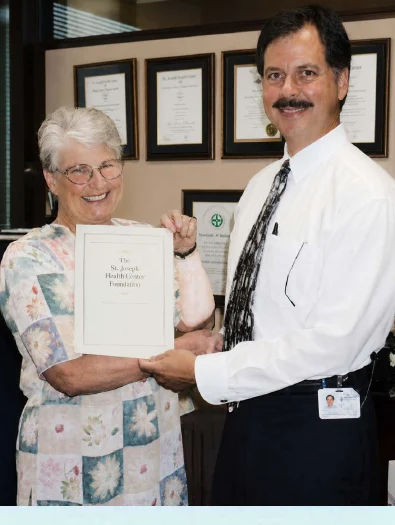
“In Gratitude for Establishing and Directing The Ethics Consultation Service at University Hospital.”
An Ethics Consultation Service is an institution, not a person, and building one is mostly political. At the University of Nebraska Medical Center I wrote the proposal, secured institutional approval, and built an eighteen-member multidisciplinary consultation service at University Hospital — six physicians, six nurses, and six others including hospital chaplains, social workers, an attorney, a psychiatrist, a genetic counsellor and an ethicist. I wrote the medical centre policy, the operating plan and the case consultation protocol; administered a twenty-four-hour on-call roster; established the service’s own bioethics education program; and put in place evaluation procedures that used client feedback to improve the work.
I chaired the University Hospital Advance Directives Task Force, a twelve-hospital regional working group formed to develop policy and procedure for implementing the Patient Self-Determination Act.
At the Mater I established the clinical ethics consultation service from scratch and worked with the Chief Operations Officer to develop on-site legal services as an active resource for the consultation process and for policy review.
Ethics that lives only at the bedside cannot protect anyone systematically. The durable work also has to reach governance and policy. At the Mater, the Hospital Ethicist provided bioethics advice and professional support to the Ethics Advisory Council, a thirteen-member body of the Mater Health Services Governing Board that sponsored ethics policy development on clinical, corporate and community matters.
Policy developed or led through that process included informed consent for post-mortem examination, confidentiality of health information, and the prenatal testing program of the Maternal-Fetal Medicine Centre. I initiated a comprehensive ethics policy review for the entire hospitals complex.
I coordinated the strategic ethics review of the proposed Queensland Statewide Maternal Fetal Medicine Service, and initiated and led the Ethical Criteria for Resource Allocation project with the Executive Leadership Team, serving on the Executive Resource Allocation Committee commissioned by the CEO.
I served as ethics consultant to each of the Mater’s research ethics committees — Adult, Mothers’, Children’s and Private — participating in the ethical review of hundreds of clinical trial protocols. I chaired the twenty-member, five-hospital planning committee that created the Mater Research Secretariat, developed and published research ethics guidelines across the complex, founded Letter from The Hospital Ethicist as a standing publication on research ethics, and participated in the NHMRC workshops implementing Australia’s National Statement on Conduct of Research Involving Humans.
I was a member of the management committee of the Perinatal Epidemiology Centre and a regular participant in the Fetal Dysmorphology Review Group — the interdisciplinary meeting convened for the most difficult cases of fetal pathology and impaired neonates.
As bioethics consultant to the External Advisory Working Group of the Joint Commission on the Accreditation of Healthcare Organizations, I helped develop the Patient Rights and Organisational Ethics section of the JCAHO accreditation standards — the standards against which American hospitals are measured. I was a participating consultant in the development of the Code of Ethical Practice for Biotechnology in Queensland, and a faculty member of the U.S. Department of Education’s national program Educating Health Care Ethics Committees: A National Dissemination Project. As Director of Outreach Programs at the University of Virginia’s Center for Biomedical Ethics, I was project officer for a Virginia Humanities grant that established ethics programs in ten Virginia hospitals and trained twenty Visiting Fellows.
Between Nebraska and Brisbane I ran Ethics Consultation Services, an independent practice delivering ethics education programmes for health care organisations. It was from that practice that I served as a faculty member of the U.S. Department of Education’s national grant project Educating Health Care Ethics Committees: A National Dissemination Project, and sat on the Joint Commission’s external advisory working group.
After the Mater I established The Ethics Consultation Group, providing custom clinical and corporate ethics programs to hospitals across Queensland — among them Redland Hospital, Royal Brisbane Hospital, Princess Alexandra Hospital, Rockhampton Hospital, Gold Coast Hospital, and the Intensive Care Society of Australia and New Zealand. Contracted to the Bayside Health Service District, I developed the health district ethics program covering Redland Hospital and the Moreton Nursing Care Unit, and convened the Bioethics Briefing 2001 seminar series with a faculty drawn from the Queensland Clinical Genetics Service, health law practice, and Queensland University of Technology.
After The Ethics Consultation Group, I ran an independent business and information technology consultancy. Later, Linda Harnett and I worked with Reconciliation Queensland delivering public education programmes, and we campaigned for the Voice to Parliament.
The work now is research, writing and communications concerned with Australian history, justice and structural change. Where that work supports First Nations-led activity, I work in a supporting role rather than claiming representative authority. The About page explains the current work, and Australian Essays holds the essays.
Doctor of Philosophy, Theological Ethics — University of Notre Dame. Specialisations: philosophical ethics, systematic theology, New Testament. Research languages: Greek, Latin, French, German. Dissertation: ‘Historical Consciousness’ in American Catholic Moral Theology Since Vatican II (University Microfilms, Ann Arbor) — a systematic study of historical consciousness in Christian theology and ethics, and how historicity has affected Catholic natural law ethics, the use of Scripture in moral argument, and the social ethics and teaching authority of the Church in secular society.
Master of Arts, Theology — University of Notre Dame.
Bachelor of Arts, Seattle University. Summa cum laude, Honors Program, European History, completed under the GI Bill. Elected to Alpha Sigma Nu, the national Jesuit university academic honour society, on the selection of the Honors Program and the History Department faculty.
Seattle Preparatory School. Jesuit secondary education, classical curriculum in Latin and Greek. Editor of the yearbook, The Echo, and First Place in impromptu speaking at the five-state tournament at Gonzaga University.
Certificate in Christianity and Culture — Christian Commonwealth Institute, Universidad de María Cristina, San Lorenzo de El Escorial, Spain (now the Real Centro Universitario Escorial-María Cristina).
The formation behind the degrees began in Loyola Hall, in Seattle University’s Honors Program: a great books curriculum in the company of Columbia, Chicago, and St John’s, but arranged and integrated historically, beginning in ancient India and China rather than Western Europe, with the Upanishads and the Bhagavad Gita. A single cohort of students read the sources whole, examined them in Socratic seminars, produced weekly term papers, and sat for close oral examinations at the end of every term. We live in imaginal space. A large lasting impact of 'the program' has been the historical, multidisplinary and cross-cultural framework for integrating knowledge. And a durable working gift is the habit of going to primary sources. Every essay I publish still practises that discipline.

United States Navy, Vietnam era — USS Enterprise (CVAN-65) and USS Constellation (CVA-64). Honorable discharge. Vietnam Service Medal.
Trained as a clinical ethics fellow with Dr John C. Fletcher, Chief Bioethicist at the National Institutes of Health, and with Dr Max Boverman, NIH Liaison Psychiatrist, prior to formal appointment as Clinical Ethics Consultant by the University of Virginia Health Sciences Center.

The Society of Christian Ethics · Catholic Theological Society of America · American Society for Bioethics and Humanities · Australasian Bioethics Association · Catholic Moral Theology Association of Australia and New Zealand
A set of clinical ethics courses built for people who had to use them the same week, alongside faculty appointments teaching bioethics and moral theology.
At the Catholic University of America, the University of Dallas, St. Norbert College, and the University of Virginia I taught social justice alongside bioethics and moral theology. The reading list changed with the decade. The question did not.
In the summer semester of 1986, at the invitation of Robert Schlagal, a former St. Norbert College colleague then directing the Summer Literacy Program, I taught Reading in English to disadvantaged minority students in the Department of English at Spring Hill College in Mobile, Alabama, while writing my doctoral dissertation.
Two seven-session course sequences, each delivered four times a year, written and taught for clinicians who would use them immediately — Basic Clinical Ethics and Moral Issues in Caring for Suffering and Dying Patients — each supported by a published resource handbook of guidelines, literature, regulation and case studies. These were not offered elsewhere in Brisbane or Queensland; enrolments increased annually and the sequence ran approximately ten times. Participants included physicians, nursing staff, chaplains, social workers, allied health clinicians, lawyers and Queensland Health Department officials.
As Director of the Intensive Colloquies and Resident Scholars Project at the University of Virginia’s Center for Biomedical Ethics, I held direct responsibility for a $300,000 grant from The Pew Charitable Trusts, planning and delivering five-day residential colloquies in health care ethics for hospital chief executives, state legislators, religious leaders, appellate judges and medical journalists — including budget, program planning, and reporting to the Pew Foundation’s executive officers.
I served as faculty for the U.S. Department of Education’s national program Educating Health Care Ethics Committees: A National Dissemination Project, teaching hospital teams how to build an ethics programme from nothing and keep one alive once built. At the Mater I delivered clinical ethics ward rounds across the complex, established the annual Clinical Research Methods and Evidence-Based Practice Course, and delivered regular corporate ethics seminars for clinical staff, managers and executives as part of the Mercy 2000 program.

The Challenge of Hospital Ethics
Hospital ethics begins not with the exceptional dilemma but with the moral imagination required to see the patient as a suffering person — and with the practical skill of being present to strangers whose lives have been fractured by illness.
“Ethics” involves not just what to do about problems but how to be with persons.Read the restored essay →

Hospitals are engines of science and bureaucracy, but they are also saturated with fear, grief, hope, courage, trust, and love. If care is to be moral as well as clinical, emotion cannot be denied; it must be recognised, interpreted, and responsibly engaged.
Our willingness to express, elicit, and listen to emotion should be understood as part of our ethical identity.Read the restored essay →

Commissioned by the Chief Executive Officer of the Mater Hospitals. Religious congregations built hospitals as moral communities to continue a healing ministry they understood as Christ’s own. With vocations in steep decline and mergers reshaping the sector, what makes such an organisation Catholic has to be articulated, integrated into corporate decision making, and refounded rather than remembered.
Catholic identity is a process, always on the pathway to fuller achievement.Read the restored white paper →
The Sir Raphael Cilento Oration — Royal Australian College of Medical Administrators, Queensland: ‘Value Based Resource Allocation: Discerning Use of Finite Resources To Meet Infinite Needs’.
Public comment on contested bioethics questions for ABC Radio National and regional television, and ethical advice on hospital participation in public projects.