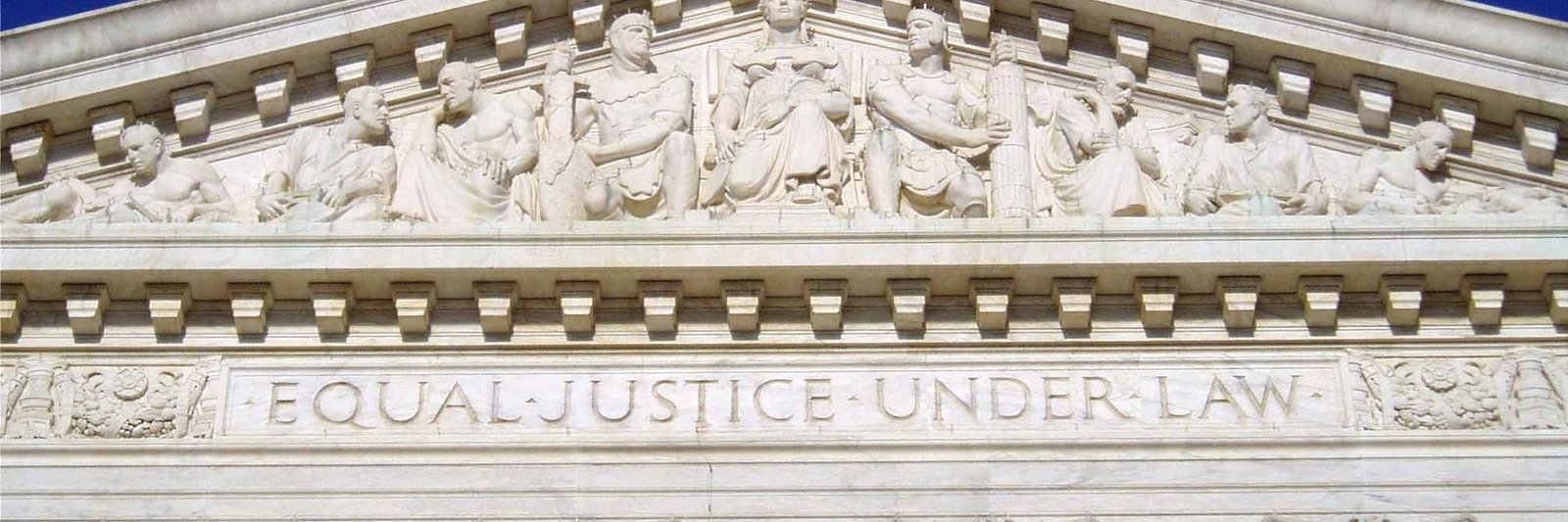
Corporate Money Built This US Supreme Court to End Equal Treatment
In 1896 Louisiana had 130,334 Black men registered to vote. By 1904 it had 1,342. Congress had repealed nothing, and no law mentioned race.
A guarantee that government must treat every person fairly and equally stayed on the page and stopped working.
Fifty years of organised money have now built a Court running the same operation, and in 2024 that Court placed the president beyond the reach of criminal law.
--------------
Two forces have run continuously through American government since the Civil War: the determination to keep political power in white hands, and the determination to keep economic power beyond democratic reach. They have never operated separately, and they have used the same instrument.
That instrument is the Fourteenth Amendment, and the story of what has been done to it is the most useful thing Americans can know about their own government.
In 1868 a new amendment forced state governments to treat every person fairly and equally
The original Bill of Rights of 1791 restrained the federal government only. A state could establish a church, censor a newspaper, or jail someone without a lawyer, and the Constitution said nothing about it.
The Fourteenth Amendment, ratified on 9 July 1868, ended that arrangement.
Its first section contains four guarantees.
Citizenship. Anyone born on American soil, and subject to the jurisdiction of the United States, is a citizen of the country and of the state where they live. The clause exists because the Supreme Court had held in Dred Scott v. Sandford in 1857 that people of African descent could never be citizens.
Privileges or immunities. No state may abridge the privileges or immunities of citizens of the United States. The drafters intended this clause to make the whole Bill of Rights binding on state governments in one stroke.
Due process. No state may deprive any person of life, liberty, or property without due process of law. Note the word person, which covers citizens and non-citizens alike.
Equal protection. No state may deny any person within its jurisdiction the equal protection of the laws.
A fifth section empowers Congress to enforce all of this by legislation, and that provision is the real transfer of authority. Before 1868 the states policed themselves in these matters. Afterwards the federal government could act against them.
Eric Foner, emeritus professor of history at Columbia University and author of the standard account of the period, calls the three post-war amendments a second founding, and the description holds literally.
Almost every right Americans can assert against a state government, a city council, a police department, a school board, or a public hospital reaches them through this single amendment.
Free speech against a mayor, a lawyer in a state criminal court, limits on what police may search, the end of school segregation in Brown v. Board of Education in 1954, the right to marry across racial lines in Loving v. Virginia in 1967: none of it would bind a state without the Fourteenth Amendment.
Between 1873 and 1903 the Supreme Court made that promise unenforceable, leaving every word in place
Within thirty years of ratification the Court had reduced the amendment to near nullity (Foner, The Second Founding). Four decisions did the work.
The Slaughter-House Cases (1873). The Court read the privileges or immunities clause so narrowly that it protected almost nothing. The Court disabled the clause that was to bind the states to the Bill of Rights five years after ratification, and it has never recovered. Litigants have routed everything the drafters expected of it through the due process clause, a provision about procedure, which is why so much modern American rights law rests on ground its opponents can plausibly call invented.
United States v. Cruikshank (1876). A white militia had murdered dozens of Black men at Colfax, Louisiana, in 1873. The Court held that the federal government could not prosecute private individuals for that violence, leaving enforcement to the state governments that tolerated it. The enforcement power was cut back the first time it was seriously used.
Plessy v. Ferguson (1896). State law may impose segregation without violating the equal protection clause.
Giles v. Harris (1903). Even where a state had plainly stripped Black men of the vote, the Court declared itself unable to supply a remedy.
Congress repealed no amendment. No convention met. The text stayed on the page, word for word, and the Court read the substance out of it.
Southern states then wrote voting laws that never mentioned race, and Black voters disappeared from the rolls
Saying that Jim Crow followed Reconstruction skips the part that matters, which is how a written guarantee became a dead letter in daily life.
The sequence took twenty-five years, and the documents record every step.
Washington withdrew federal protection. An arrangement the following year settled the disputed presidential election of 1876, placing Rutherford Hayes in office and removing the remaining federal troops from South Carolina and Louisiana. Democratic governments took control across the former Confederacy, assisted by organised paramilitary violence of the kind the Court had just placed beyond federal reach in Cruikshank.
States then rewrote their own constitutions. Mississippi went first, in 1890. Its convention faced a drafting problem, since the Fifteenth Amendment forbade denying the vote on racial grounds, and it solved the problem with qualifications that never mention race: a residency requirement, an annual poll tax of two dollars, a literacy test, and an understanding clause permitting a local registrar to decide whether an applicant had grasped a passage of the state constitution read aloud to them. Registrars applied the standard strictly to Black applicants and leniently to white ones.
The effect was immediate and measurable. Of roughly 147,000 eligible Black men in Mississippi, fewer than 9,000 remained registered by 1892, against 70,000 white voters. The Republican presidential vote in the state fell from 26 per cent in 1888 to under 3 per cent in 1892 (Mississippi Encyclopedia).
The Supreme Court approved the design. In Williams v. Mississippi, decided unanimously on 25 April 1898, it held the scheme non-discriminatory, on the reasoning that the text said nothing about race.
Seven states copied it. South Carolina in 1895, Louisiana in 1898, North Carolina in 1900, Alabama in 1901, Virginia in 1902, Georgia in 1908, and Oklahoma in 1910. Louisiana’s figures appear above.
A one-party South followed, and it lasted until the Voting Rights Act of 1965. Americans kept their rights on paper and lost them in fact for roughly ninety years.
The substance returned only when a later Court and a later Congress put it back, piece by piece: Brown in 1954, the Civil Rights Act of 1964, the Voting Rights Act of 1965, and a long sequence of rulings that finally applied most of the Bill of Rights against the states through the due process clause.
Litigators and legislators won each piece from the beginning.
During those same years the Court handed that promise to railroad and insurance companies instead
The Court stayed busy through those years with the same amendment, on behalf of different clients.
In Santa Clara County v. Southern Pacific Railroad (1886) the reporter’s headnote recorded that corporations count as persons under the equal protection clause.
The holding itself decided a tax question and said no such thing, but lawyers cited the headnote as though it had, and corporate personhood entered American law through a clerical note rather than a judgment.
In Lochner v. New York (1905) the Court used the due process clause to strike down a state law limiting bakers to sixty hours a week, on the reasoning that it interfered with liberty of contract.
For the next three decades the same clause defeated minimum wage laws and child labour laws across the country.
Justice Hugo Black put the proportions on the record, dissenting in Connecticut General Life Insurance Co. v. Johnson in 1938. Of the Fourteenth Amendment cases the Court decided in the first fifty years after ratification, he wrote, less than one half of one per cent invoked it to protect Black Americans, and more than half asked that its benefits be extended to corporations (Hugo Black Digital Library).
A 1912 study of 604 such cases found the same pattern, with under five per cent concerning African Americans, who lost nearly all of theirs.
One amendment, one Court, one stretch of years. The Court made a clause written to protect freedmen useless to them and highly serviceable to capital.
Explaining that requires no conspiracy. Judges reached for the argument the better-funded litigant put in front of them, over and over, for fifty years.
After 1965 the Republican Party won the white South, and learned to govern without winning most votes
Steven Levitsky and Daniel Ziblatt teach government at Harvard, and their Tyranny of the Minority (2023) dates the decisive modern turn to the years after 1965.
Into the 1960s, both American parties were broad coalitions dominated by white Christians, which is why both voted heavily for the Civil Rights Act of 1964 and the Voting Rights Act of 1965.
The Republican Party then adopted what they call a white-party strategy as its route to power (review).
The steps are traceable. Barry Goldwater voted against the 1964 Act and carried five Deep South states in an election he otherwise lost badly, which demonstrated that the region could be taken.
Richard Nixon campaigned in 1968 and 1972 on law and order and on opposition to court-ordered school busing.
By 1972 the transfer was complete, and white southern voters who had been Democrats since Reconstruction had become the base of the Republican Party. The religious right consolidated the arrangement across the following two decades.
A party that becomes an electoral minority can then hold power through institutions that weight some voters more heavily than others:
the Electoral College, a Senate that gives Wyoming and California the same two votes, and the filibuster, which lets forty-one senators block most legislation.
Fifty senators represent the twenty-five smallest states and roughly 53.5 million people, while fifty represent the twenty-five largest and 278.6 million.
The five smallest states are 78 per cent white against 46 per cent in the five largest, so the numerical bias and the racial one travel together (Washington Post).
The Court legalised unlimited political money in 2010, and that money then paid to select the justices
The nineteenth-century pattern needed no organisation. The modern version is organised, and its participants have described the work openly.
In Citizens United v. Federal Election Commission (2010) the Court held, five to four, that the First Amendment forbids limits on independent political spending by corporations and unions.
Money at any scale became a protected form of speech, and the pools of capital that followed were free to operate without disclosure.
Leonard Leo, co-chair of the Federalist Society, has advised on every conservative nomination to the Supreme Court since John Roberts, and groups in his network spent millions to prevent the Senate from considering Merrick Garland in 2016.
In 2021 Barre Seid, a Chicago manufacturing magnate, transferred his company to Leo’s Marble Freedom Trust, which sold it for \$1.6 billion while avoiding as much as \$400 million in tax.
It was the largest known donation to a political advocacy group in American history, and Leo holds primary authority over how it is spent (ProPublica).
A House committee record documents that Leo met Seid through an introduction arranged by the Federalist Society’s longtime director (Committee on House Administration).
Trace the sequence. A Court permitted unlimited political money in 2010. That money financed the selection and confirmation of the justices who now hold the majority. Those justices then withdrew the remedies.
Shelby County v. Holder (2013). Until this ruling, states with a documented history of racial discrimination in voting had to obtain federal approval before changing their election rules. The Court ended that requirement.
Rucho v. Common Cause (2019). Federal courts may not hear complaints that mapmakers drew a district to entrench one party, however extreme the drawing (opinion). The remedy ceased to exist. A mid-decade redistricting wave followed across Texas, Missouri, North Carolina, Ohio, Utah, and Florida.
Louisiana v. Callais (29 April 2026). Section 2 of the Voting Rights Act is the surviving enforcement provision, the clause that lets voters sue when a map dilutes minority voting strength. Deciding six to three, the Court held that Louisiana’s second majority-Black district was an unconstitutional racial gerrymander, and rewrote what a challenger must prove.
A plaintiff must now establish racial motive on the part of the mapmakers, and a state may answer that it discriminated by political party instead. Justice Elena Kagan wrote in dissent that the ruling makes “a nullity of Section 2” (opinion).
Read that last one against the amendment. Congress wrote the equal protection clause in 1868 to protect Black citizens from state governments.
In 2026 it struck down a district drawn to give Black voters representation. The clause kept every word. Its direction of fire reversed.
Clarence Thomas and Samuel Alito took secret gifts from billionaires, and Alito ruled for the man who flew him to Alaska
Financing the selection of judges is lawful. What ProPublica documented between 2023 and 2025 goes further.
Justice Clarence Thomas accepted at least 38 destination vacations and 26 private jet flights from billionaire benefactors, in most years across more than two decades, and disclosed almost none of them. Harlan Crow, a Dallas real estate magnate and Republican donor, paid private school tuition for the grandnephew Thomas was raising as a son, and bought Savannah property from Thomas and his relatives in a 2014 transaction Thomas never reported.
Anthony Welters lent Thomas \$267,230 toward a motor home, and a substantial portion of that loan went unrepaid.
Legal ethics specialists concluded that Thomas appeared to have broken the federal disclosure statute (ProPublica).
Justice Samuel Alito flew to Alaska in 2008 on a private jet provided by Paul Singer, a hedge fund billionaire, on a trip whose airfare alone could have exceeded \$100,000 one way.
Alito disclosed none of it. Singer’s fund subsequently appeared before the Court at least ten times.
In 2014 the Court resolved a decade-long dispute between that fund and the Republic of Argentina. Alito declined to recuse, voted with the seven-to-one majority in Singer’s favour, and the fund eventually collected \$2.4 billion (ProPublica).
Leonard Leo helped organise that Alaska trip and attended. The Senate Judiciary Committee authorised subpoenas for Crow and for Leo in the same ethics inquiry (ProPublica).
One man therefore appears at both ends of the arrangement: choosing the nominees, and hosting the sitting justices alongside the donors whose interests reach the Court.
The documents record no vote exchanged for money. They record a judiciary selected, funded, and entertained by one network, and the Argentina case shows the result.
A president who cannot be prosecuted, holding regulators he can fire, completes the arrangement
Trump v. United States (1 July 2024). The Court held, six to three, that a president has absolute immunity from criminal prosecution for official acts at the core of the office, and presumptive immunity for the rest (opinion).
Trump v. Slaughter (29 June 2026). Since 1935, under a precedent called Humphrey’s Executor, the heads of independent agencies such as the Federal Trade Commission could be dismissed only for cause, which is what made them independent.
The same six-to-three majority overruled it (Congressional Research Service).
A president who cannot be prosecuted for official acts, holding regulators he may dismiss at will, supplies exactly what a faction needs once it has stopped expecting to win majorities.
It is also the arrangement that ends federal supervision of the wealthiest firms in the country. Voting rules serve the first of the two forces. Regulatory collapse serves the second. A single institution delivers both.
The Court has not been unanimous in this work. Executive Order 14156, issued on 20 January 2025, sought to deny citizenship to American-born children of undocumented mothers and of temporary visitors.
On 30 June 2026, in Trump v. Barbara, the Court struck it down. Chief Justice John Roberts wrote the majority opinion, joined by Justices Kagan, Sotomayor, Barrett, and Jackson, holding that children born in the United States to parents unlawfully or temporarily present fall under the jurisdiction of the country and are citizens at birth.
Justice Kavanaugh concurred on statutory grounds. Justices Thomas, Alito, and Gorsuch dissented (National Constitution Center).
The Citizenship Clause held. Three justices voted to abandon it, and a fourth declined to rest on it, but it held.
Six weeks later the administration issued a further order, “Continuing to Protect the Meaning and Value of American Citizenship,” which reads that ruling as narrowly as the text allows and sets out fresh categories of American-born children it proposes to exclude, beginning with the children of anyone the government designates an alien enemy (order).
The administration attacked a constitutional guarantee, lawyers defended it, and the highest court upheld it.
The attack resumed inside two months.
Fair treatment means deciding about people one at a time, which a government-wide database ends
The clause forbidding a state to deprive any person of life, liberty, or property without due process uses the word person deliberately. Its protection reaches everyone inside the country’s borders, and its premise is that government must decide about people one at a time, on a record, with a chance to answer.
A system that assembles a dossier on everybody in advance dispenses with that premise, and the government is building one.
Palantir Technologies drew 54 per cent of its 2025 revenue from government contracts, reported \$4.8 billion in revenue for that year, and is valued above \$300 billion (Multinationals Observatory).
It holds a \$30 million contract with Immigration and Customs Enforcement for immigrant surveillance.
The New York Times reported that the government engaged the company to build a federal data platform drawing records on citizens across agencies, reaching bank account numbers, student debt, medical claims, and disability status.
The Department of Government Efficiency hired numerous former Palantir employees and tapped the company to construct a master immigration database intended to accelerate deportations (NPR).
By May 2026 federal agencies were obstructing a Government Accountability Office inquiry into what data those personnel had reached (MS NOW).
Alex Karp, the company’s chief executive, told shareholders that disruption in Washington would prove “very good for Palantir.”
A financial disclosure published in May 2026 showed the president trading Palantir and Nvidia shares while his administration regulates and enriches both firms.
Recall what Trump v. Slaughter accomplished five weeks later. The agencies that would examine such arrangements now serve at the president’s pleasure.
The nineteenth-century Court handed the due process clause to railroads seeking exemption from labour law. The present arrangement removes it from everyone a database can reach.
Teaching a false history of Reconstruction came first, and the White House now orders the same falsification
W. E. B. Du Bois, the first African American to earn a doctorate from Harvard, closed Black Reconstruction in America in 1935 with a chapter titled “The Propaganda of History.”
He had intended it as a survey of his sources. He found instead that he had to write “an indictment of their ideals,” having shown that the account of Reconstruction taught in American schools rested on the testimony of men who treated lying about Black citizens as a form of filial duty (text).
David W. Blight of Yale later mapped how the falsification took hold. His Race and Reunion (2001) argues that white America purchased its unity through the segregation of Black and white memory of the Civil War, with a sentimental account of brothers in shared valour fusing with an explicitly white supremacist one and displacing the emancipationist memory Frederick Douglass spent his last decades defending (Race and Reunion).
The connection to the amendment is direct. A country persuaded that Reconstruction was a corrupt failure imposed by vindictive northerners will not defend what Reconstruction built.
The Mississippi convention of 1890 met in a national atmosphere already prepared to regard Black voting as an error requiring correction, and northern newspapers and northern universities had done much of the preparing.
That operation now runs with state machinery behind it, and the orders state their premise openly.
Executive Order 14253, “Restoring Truth and Sanity to American History,” issued on 27 March 2025, opens with a finding.
Over the previous decade, it says, a concerted effort rewrote American history, replacing objective fact with a narrative driven by ideology. It names the offence precisely. That effort recast a national legacy of advancing liberty, individual rights, and human happiness as inherently racist, sexist, and oppressive. The Smithsonian, the order continues, has fallen under a “divisive, race-centered ideology” (Federal Register).
Read that as a proposition, because it is one.
It holds that American history records a people striving toward their founding principles. It holds that slavery, segregation, and exclusion belong inside that account as failures along the way. And it holds that treating racial subordination as a structural feature of American government divides the country, which makes such treatment the offence requiring correction.
Noticing race is the error.
The Domestic Policy Council report of 4 July 2026, “Saving America’s Story,” runs 162 pages and states the prescribed content directly.
A national museum should explain how Americans came to reject Jim Crow and segregation, the report says, by adopting “a colorblind standard derived from America’s founding documents” (report).
The report also instructs that the museum should trace slavery to British and global practice, credit the Founders with sparking the movement that ended it, and set the whole account within a story of a people striving, imperfectly and often nobly, toward liberty and equality.
It identifies the enemy doctrine by name as intersectional critical theory rooted in Marxism, and it recommends that every entrance carry a warning label about curators who want visitors to stop loving their country.
Four instruments enforce the doctrine.
Removal. The order directs the Vice President, who sits on the Smithsonian Board of Regents, to remove improper ideology from the museums, the research centres, and the National Zoo.
Money. Future appropriations are to prohibit spending on exhibits that degrade shared American values or divide Americans by race. The Smithsonian received $1,080,500,000 in federal appropriations for the 2026 financial year. An exhibit documenting the Mississippi poll tax divides Americans by race under that standard.
Monuments. The Secretary of the Interior is directed to reinstate statues, markers, and monuments removed or renamed on federal land in the previous five years. That window covers the removals that followed May 2020, when 168 Confederate symbols came down or changed names across the country, 94 of them monuments (NPR). The order therefore commands the physical re-erection of the Lost Cause that Blight described.
Appointments. The Vice President is to work with congressional leaders to seat citizen Regents committed to advancing the policy. The report additionally urges the Chief Justice of the United States, who chairs the Board as Chancellor, to act on its findings.
A second order on 24 July 2026 extended that oversight through the anniversary year (order). The American Historical Association answered that the order egregiously misrepresents the Institution’s work (AHA).
Now set the prescribed history beside the Court.
The report requires a museum to teach that America defeated Jim Crow by adopting a colourblind standard.
In Callais the Court struck down a district drawn to give Black voters representation, because drawing it required attention to race.
The executive orders would defund an exhibit that divides Americans by race.
One doctrine runs through all three: that noticing racial subordination constitutes the wrong.
A government that holds this cannot enforce the Fourteenth Amendment for the people it was written to protect, because enforcement begins with counting exactly what the doctrine forbids anyone to count.
Du Bois faced a professoriate. The Association faces an executive order. That is the difference between 1935 and now, and it runs in one direction only.
Mississippi’s 1890 constitution never mentioned race, which is exactly why it worked
The colourblind standard deserves a direct answer, and the record supplies one.
Justice John Marshall Harlan produced the phrase, dissenting alone in Plessy v. Ferguson in 1896. “Our constitution is color-blind,” he wrote, and it knows no classes among citizens (text).
Read the sentence where it stands. Harlan was objecting to a Louisiana statute that sorted railway passengers by race in order to subordinate one of them. He demanded that government stop classifying people to hold them down. He wrote in dissent, in defence of Black citizenship, against the decision that authorised segregation for the next fifty-eight years.
His own paragraph makes the distinction that matters, and it makes uncomfortable reading. In the sentences immediately before the famous one, Harlan granted that the white race held dominance in prestige, achievement, education, wealth, and power, and he expected that dominance to continue.
Then he drew his line. Before the law, he wrote, the country contains “no superior, dominant, ruling class of citizens” (dissent).
Harlan was describing a social condition and refusing to let the law enforce it. The modern usage collapses those two things, treating the social condition as settled and forbidding the law to reach it.
Since the 1970s the phrase has served the opposite purpose.
Douglas Reed of Georgetown traces how opponents of school desegregation and affirmative action adopted Harlan’s words after losing in court, and argues that race-conscious remedies fulfil his objective, which was the full citizenship of Black Americans (Russell Sage Foundation Journal).
The Congress that wrote the Fourteenth Amendment worked in full knowledge of race.
The same legislators passed the Freedmen’s Bureau Acts of 1865 and 1866, directing federal relief, land, schooling, and legal protection to freed slaves by name. Justices Sotomayor and Jackson have both placed that record in the United States Reports.
The decisive evidence appears earlier in this account.
Mississippi’s constitution of 1890 never mentioned race. Its drafters faced the Fifteenth Amendment and wrote around it, using a residency requirement, a two-dollar poll tax, a literacy test, and a registrar’s discretion.
Black registration fell from roughly 147,000 eligible men to fewer than 9,000 within two years.
The Supreme Court then upheld the scheme unanimously in Williams v. Mississippi, on the reasoning that the text said nothing about race.
Colourblind drafting built Jim Crow. Seven states copied the design, and the arrangement held for three-quarters of a century.
The rule works the same way now. Callais requires a plaintiff to prove that mapmakers acted from racial motive, and lets a state answer that it discriminated by party instead.
A state that keeps race out of its stated reasons keeps its map.
A standard forbidding government to notice race protects every exclusion that avoids saying so aloud. It disarms the remedy and leaves the machinery running.
The Domestic Policy Council would have American schoolchildren taught that this standard defeated Jim Crow.
Mississippi wrote the standard into its constitution and disfranchised a state with it.
A racial minority and the richest firms are building rule for themselves, which describes the case more exactly than fascism
Professional historians may disagree about whether the word fascism fits, but the ‘definitional argument’ swallows the evidence whenever it starts. The record supports something more exact.
The project aims at a government answerable to a shrinking racial minority and to the largest fortunes in the country, insulated by design from the count of heads.
The two interests have used one instrument throughout.
The Court that read the Fourteenth Amendment out of existence for freedmen read it into existence for railroads in the same years, and the Court that has closed the federal courts to gerrymandering claims has also placed the president beyond criminal law and stripped the independence of federal regulators.
Every American advance toward inclusion has drawn a matching reassertion, and the reassertions have taken roughly the same form each time: federal protection withdrawn, state governments left to act, and courts declining to intervene. The evidence establishes historical recurrence.
The Louisiana numbers state the case exactly. In 1896 the state had 130,334 Black men on its rolls, and in 1904 it had 1,342.
Congress had repealed nothing. The Constitution read exactly as it had read before. The guarantee was still printed, and it had stopped functioning, and restoring its workability took sixty more years and the deaths of many people who did the work of restoring.
A constitutional guarantee holds for exactly as long as the people decide to hold it.
---------------------------