Refounding Must Never Finish
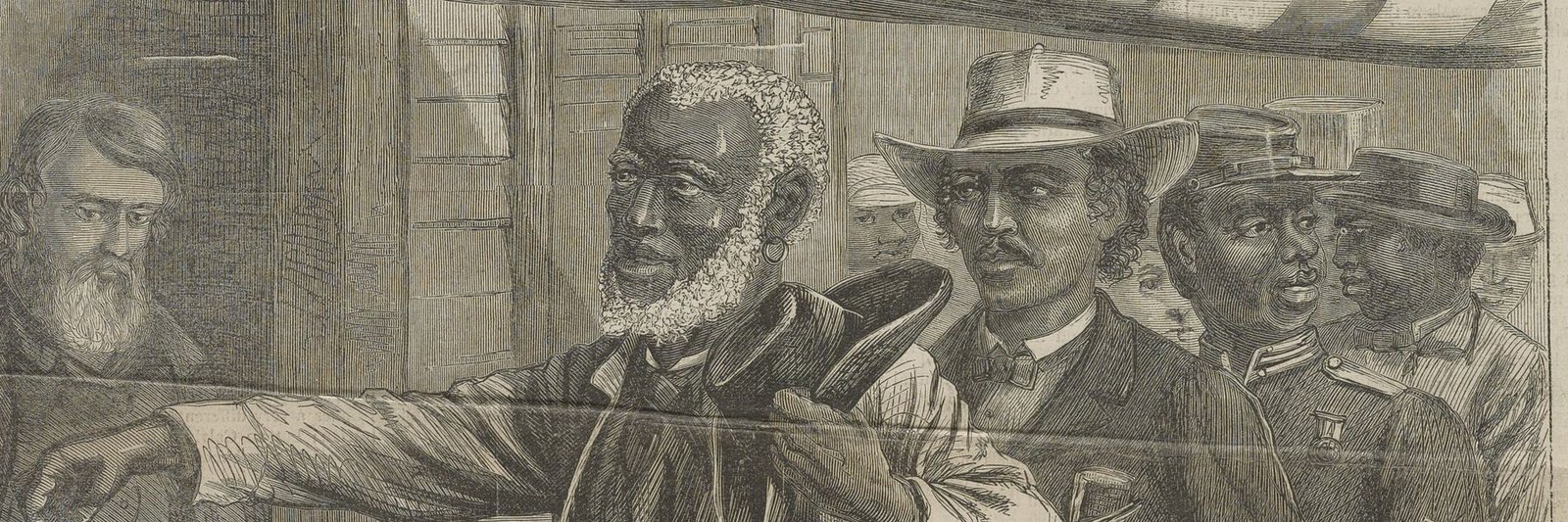
The Fourteenth Amendment was a refounding. Men who had just fought a war wrote it, knowing precisely which dangers they meant to prevent, and it held for about thirty years. The belief that history corrects such reversals by itself is a theological inheritance in secular dress, and it left two generations expecting time to do work that only people do.
“The arc of the moral universe is long, but it bends toward justice.”
Almost everyone in the English-speaking world has met that sentence. It has appeared in presidential speeches, on protest placards, in eulogies, and around the border of a rug in the Oval Office. It is generally attributed to Martin Luther King, and it is generally understood to describe how history works.
Both men who gave that sentence its currency described a hope they could not verify.
The preacher who wrote the line about the arc said he could not see it and was guessing
Theodore Parker (1810 to 1860) preached in Boston as a Unitarian minister, campaigned against slavery without compromise, and reached readers including Abraham Lincoln through his printed sermons. He produced the figure in 1853, in a sermon called “Of Justice and the Conscience.”
Parker disclaims any understanding of the moral universe. He grants that the arc runs long and that his own eye reaches only a little way. He states that he cannot calculate the curve or complete the figure by sight. He can, he says, “divine it by conscience” (Parker, 1853).
A minister expresses a hope and marks its limits in the same breath. The passage records a faith.
King had read him, having taken a doctorate in systematic theology at Boston University in 1955, and he treated the line as borrowed goods, placing it inside quotation marks when he first put it into print in 1958. He also said the opposite of what the sentence is now used to mean. Writing from the Birmingham city jail in April 1963, he warned that “human progress never rolls in on wheels of inevitability.” Progress comes through tireless effort, he wrote, and without it time becomes an ally of stagnation, and people of ill will had been using time far more effectively than people of good will (Letter from Birmingham Jail).
I have said, more than once, that King was wrong about the arc. That verdict misplaces the error. The error belongs to the civil religion that grew up around the sentence, stripped away Parker’s hedge and King’s warning, and treated a devotional utterance as a law of motion.
The idea that history moves toward justice is Christian expectation stripped of God
Karl Löwith (1897 to 1973) was a German philosopher who lost his university position under the Nazi race laws and left Germany in 1934 for Italy, then Japan, then the United States. He wrote Meaning in History in exile and published it in 1949. It remains the standard account of why the modern West believes what it believes about progress.
His case is that modern philosophies of history present themselves as secular when they are in fact secularised, which is a different thing. The conviction that history moves toward a consummation descends directly from the Jewish and Christian scheme of salvation, and the descent survives intact in thinkers who considered themselves finished with theology. The Greeks handed down an intelligible cosmos with no goal in it. Christianity handed down a linear history aimed at an end beyond history altogether. Modern historical consciousness welds the two together, keeps the shape of the older expectation, substitutes faith in humanity for faith in God, and is incoherent as a result (Religions 12:6).
Hans Blumenberg contested that genealogy in 1966, arguing that progress arose from human self-assertion rather than from repurposed theology, and historians of ideas still argue the point. Löwith holds the ground that matters here however it resolves: a direction in history is a doctrine, and nobody has ever measured one.
He wrote the book during the years of the camps and the atomic bomb, and noticed that the same civilisation which produced the most confident theories of historical advance had also produced those. That observation supplies the evidence.
Americans built a new constitutional order in 1868, and it stopped working within thirty years
The American record supplies a decisive example.
The Fourteenth Amendment, ratified in 1868, established that everyone born on American soil is a citizen, forbade any state to deny due process or the equal protection of the laws, and gave Congress the power to enforce those guarantees against the states. Men who had just fought a war over exactly this question drafted it. They knew precisely who their opponents were, and they moved enforcement away from the state governments they had watched abuse it. It was the most ambitious institutional redesign in American history after 1787.
Between 1873 and 1903 the Supreme Court read the substance out of it, decision by decision, while Congress repealed nothing and no convention met. Southern states then rewrote their own constitutions with voting qualifications that never mentioned race, and the Court approved the design. Louisiana had 130,334 Black men registered to vote in 1896 and 1,342 in 1904. During the same years the Court extended the amendment’s protection to corporations with such enthusiasm that Justice Hugo Black, counting in 1938, found that under one half of one per cent of Fourteenth Amendment cases in the first fifty years had been brought to protect Black Americans, while more than half sought its benefits for companies.
Ninety years passed before the substance returned, and it returned because people put it back one case and one statute at a time.
Jefferson wanted every constitution to expire after nineteen years, and Madison talked him out of it
Thomas Jefferson wrote to James Madison from Paris on 6 September 1789 that no society can make a perpetual constitution, or even a perpetual law, because the earth belongs always to the living generation. Every constitution expires at the end of nineteen years, he argued, and enforcing one beyond that term makes it an act of force rather than of right (letter).
His reasoning is the part worth attention. Jefferson anticipated the obvious objection, that a later generation can simply repeal what it dislikes, and rejected it. The power of repeal is no equivalent, he wrote, because representation is unequal and vicious, various checks obstruct every legislative proposal, factions take possession of the public councils, and bribery corrupts them.
The author of the Declaration set out that argument in 1789. Madison replied on 4 February 1790 that the scheme ignored the debts each generation owes the last and would prove impracticable (rebuttal). Madison won. The founders built for permanence, and the record since suggests Jefferson had the better instinct.
Timothy Snyder wants Americans to rebuild instead of going back, and rebuilding by itself has already failed once
Timothy Snyder of Yale argued in August 2026 that the United States is undergoing an authoritarian regime change, and that the opposition should stop promising to restore what existed before, since those conditions produced this. Nobody can save the house from burning, on his account, because it has already burned, and the question is who can be trusted to build a new one (Katie Couric Media, 13 August 2026).
He is right about restoration. Returning to the arrangements of five years ago restores the conditions that produced the present.
His account of what follows stops short, and the Fourteenth Amendment shows why. That amendment refounded the republic and restored nothing. People with no illusions whatsoever about the good faith of their opponents wrote it, and a Court dismantled it clause by clause while the machine sat there, fully drafted, exactly as written.
No design defends itself. Rebuilding remains necessary work that secures nothing permanently, and treating a new structure as the solution repeats in institutional form the error the arc represents in philosophical form: the belief that justice can be placed somewhere safe, beyond the reach of politics, and left there. Refounding is a condition of holding a republic, which is why it must never finish.
Giving up the idea that history bends toward justice costs nothing worth keeping
Augustine settled the question for Western Christian thought in The City of God, completed in 426. The earthly city never becomes the City of God. Justice belongs to an end beyond history, and no political achievement inside history completes it. Löwith’s contribution was to show that modern secular optimism kept Augustine’s shape and discarded his warning.
A person who arrives at the settled conviction that a fully realised just society will not come within their lifetime loses a bad theory. The theory only felt load-bearing.
Reinhold Niebuhr drew the consequence at the close of The Irony of American History in 1952. “Nothing that is worth doing can be achieved in our lifetime,” he wrote, and therefore hope must do the work; nothing true or good makes complete sense within any immediate stretch of history, and therefore faith must; nothing virtuous gets accomplished alone, and therefore love must (text).
A harder consequence follows. The interests now completing their work never believed in the arc. They believed in decades, in state legislatures, in judicial appointments, and in the slow accumulation of small institutional advantages held past the point where anyone was still watching. Their opponents, holding a doctrine of assured progress, treated time as a friend. King told them otherwise from a jail cell in 1963, in plain words, and almost nobody heard him.
Nothing guarantees the outcome. That was always true. It is now merely visible, and visibility is worth a great deal. Jefferson set the term at nineteen years. The Fourteenth Amendment lasted thirty. Neither figure is a prediction, and both make the same point: a generation inherits the text and nothing else. The rest has to be won again by the people currently alive. The work must never finish, and a faction that has waited fifty years is relying on the belief that it can.